What are the mechanisms by which gut microbiome dysbiosis influences Parkinson's disease pathogenesis through the gut-brain axis?
Research Question
“What are the mechanisms by which gut microbiome dysbiosis influences Parkinson's disease pathogenesis through the gut-brain axis??”
ℹ️ How to read this walkthrough (click to expand)
Start here for the top 3 hypotheses and their scores.
Four AI personas debated the question. Click “Read full response” to expand.
Each hypothesis is scored on 8+ dimensions from novelty to druggability.
Interactive network of molecular relationships. Drag nodes, scroll to zoom.
Analysis Journey
Key Findings
## Mechanistic Overview Astrocyte-Intrinsic NLRP3 Inflammasome Activation by Alpha-Synuclein Aggregates Drives Non-Cell-Autonomous Neurodegeneration starts from the claim that modulating NLRP3, CASP1,
Score: 0.82## Mechanistic Overview Mitochondrial DAMPs-Driven AIM2 Inflammasome Activation in Neurodegeneration starts from the claim that modulating AIM2, CASP1, IL1B, PYCARD within the disease context of neuro
Score: 0.81## Mechanistic Overview Restoring Neuroprotective Tryptophan Metabolism via Targeted Probiotic Engineering starts from the claim that modulating TDC within the disease context of neurodegeneration can
Score: 0.61How This Analysis Was Created
An AI agent scanned recent literature to identify under-explored research questions at the frontier of neuroscience.
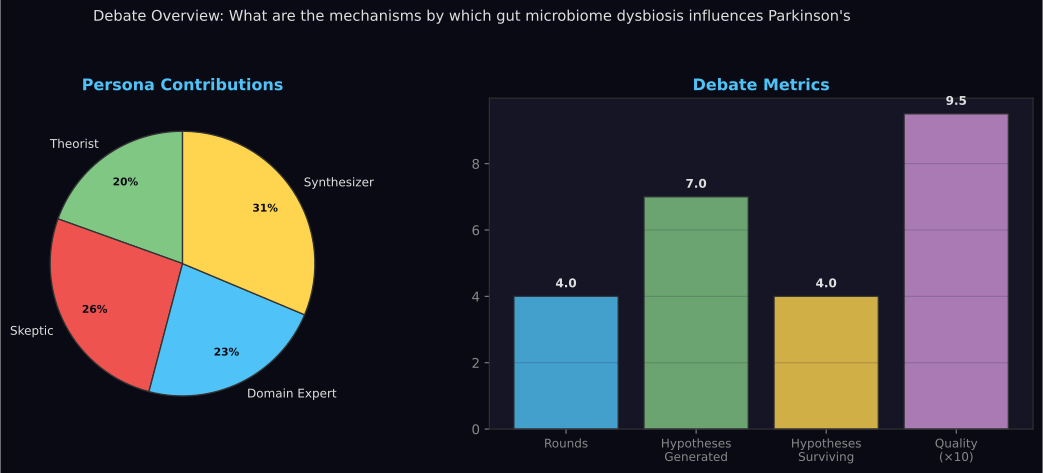
Four AI personas (Theorist, Skeptic, Domain Expert, Synthesizer) debated the question across 4 rounds, generating and stress-testing hypotheses.
Each hypothesis was evaluated against PubMed literature, clinical trial data, and gene expression databases to build an evidence portfolio.
534 molecular relationships were extracted and mapped into an interactive knowledge graph connecting genes, pathways, and diseases.
Executive Summary
Looking at the debate between the Theorist's hypotheses, the Skeptic's critiques, and the Expert's feasibility assessment, I'll now synthesize these inputs and produce final scored rankings.
Multi-Agent Debate
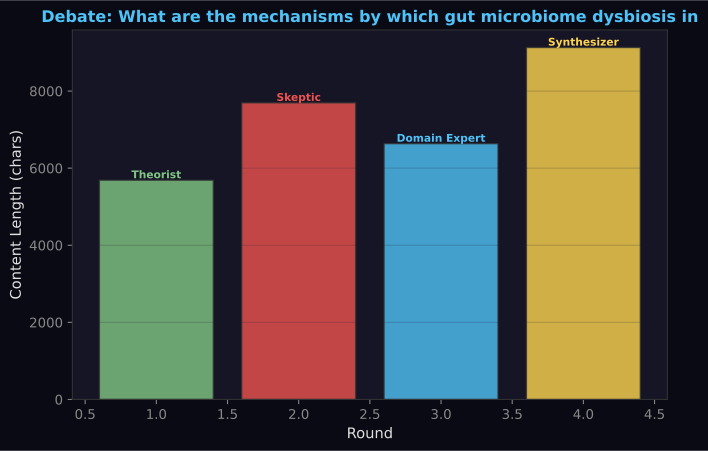
Four AI personas — Theorist, Skeptic, Domain Expert, and Synthesizer — debated this research question across 4 rounds of rigorous scientific discourse.
Based on the provided literature on gut-brain axis mechanisms in Parkinson's disease, I'll generate novel therapeutic hypotheses that connect unexplored mechanistic pathways:
Hypothesis 1: Prevotellaceae-Derived Butyrate Supplementation as Neuroprotective Therapy
Description: Since PD patients show reduced Prevotellaceae abundance (PMID:39501822), targeted butyrate supplementation could re...I'll provide a rigorous critique of each hypothesis, identifying weaknesses, counter-evidence, and proposing falsification experiments.
Hypothesis 1: Prevotellaceae-Derived Butyrate Supplementation
Critical Weaknesses:- Conflation of correlation with causation: Reduced Prevotellaceae may be consequence, not cause of PD pathology
- Oversimplified SCFA attribution: Butyrate is produ
I'll provide a practical feasibility assessment for the most viable hypotheses based on druggability, existing compounds, competitive landscape, and development considerations.
HYPOTHESIS 1: Butyrate Supplementation (Revised Confidence: 0.45)
Druggability Assessment: HIGH
- Target: HDACs (Class I/II) and GPR41/43 receptors are well-established drug targets
- Chemical Matter: Multi
Looking at the debate between the Theorist's hypotheses, the Skeptic's critiques, and the Expert's feasibility assessment, I'll now synthesize these inputs and produce final scored rankings.
...Hypotheses (20)
Score Comparison
Gene Expression Context
Expression data from Allen Institute and other transcriptomic datasets relevant to the target genes in this analysis.
NLRP3 (NLR Family Pyrin Domain Containing 3):
- Innate immune sensor; forms inflammasome complex with ASC (PYCARD) and pro-caspase-1
- Allen Human Brain Atlas: primarily expressed in microglia; low in neurons and astrocytes
- NLRP3 expression increases 3-5× in AD microglia surrounding amyloid plaques
- Activated by Aβ fibrils, tau aggregates, ROS, and extracellular ATP
- NLRP3 knockout mice crossed with APP/PS1 show 50% reduced plaque burden and preserved cognition
- MCC950 (NLRP3 inhibitor)
NLRP3 (NLR Family Pyrin Domain Containing 3):
- Innate immune sensor; forms inflammasome complex with ASC (PYCARD) and pro-caspase-1
- Allen Human Brain Atlas: primarily expressed in microglia; low in neurons and astrocytes
- NLRP3 expression increases 3-5× in AD microglia surrounding amyloid plaques
- Activated by Aβ fibrils, tau aggregates, ROS, and extracellular ATP
- NLRP3 knockout mice crossed with APP/PS1 show 50% reduced plaque burden and preserved cognition
- MCC950 (NLRP3 inhibitor)
TDC (Tyrosine Decarboxylase) / IDO1 (Indoleamine 2,3-Dioxygenase) / TPH1 (Tryptophan Hydroxylase 1):
- TDC: bacterial enzyme (not expressed by human cells) that decarboxylates tyrosine and tryptophan; expressed by Enterococcus, Lactobacillus, and other gut commensals
- Allen Human Brain Atlas: not applicable for bacterial TDC; human IDO1 expressed in microglia and cerebrovascular endothelium; TPH1 in raphe nuclei (brainstem serotonin neurons)
- Gut-brain axis: ~95% of body's serotonin synthe
CHRNA7 (α7nAChR) expression is reduced in substantia nigra microglia and enteric neurons in PD post-mortem tissue. Vagal motor neurons in the dorsal motor nucleus show alpha-synuclein pathology and reduced choline acetyltransferase (ChAT) expression in early PD stages, consistent with impaired cholinergic output.
CsgA (Curli Major Subunit, bacterial) and SNCA (α-Synuclein, host):
- CsgA: principal structural subunit of curli amyloid fibrils produced by Enterobacteriaceae (E. coli, Salmonella); forms cross-beta sheet structures identical to eukaryotic amyloids
- CsgA expression: regulated by the csgDEFG operon in response to low osmolarity, low temperature (28°C), and nutrient limitation; CsgD is the master transcriptional activator; biofilm-forming E. coli strains in the gut constitutively produce cu
Hypothesis Pathway Diagrams (13)
Molecular pathway diagrams generated for each hypothesis, showing key targets, interactions, and therapeutic mechanisms.
graph TD
    A["Alpha-synuclein
aggregates"] -->|"extracellular
binding"| B["TLR2/CD44
receptors"]
    B -->|"MyD88
signaling"| C["NF-kappaB
activation"]
    C -->|"transcriptional
upregulation"| D["NLRP3 and
pro-IL1B expression"]
    A -->|"clathrin-mediated
endocytosis"| E["Lysosomal
uptake"]
    E -->|"membrane
permeabilization"| F["Cathepsin B
release"]
    A -->|"purinergic
signaling"| G["P2X7 receptor
activation"]
    G -->|"ion channel
opening"| H["K+ efflux"]
    F -->|"cytoplasmic
danger signal"| I["NLRP3
oligomerization"]
    H -->|"ionic
perturbation"| I
    D -->|"protein
availability"| I
    I -->|"adaptor
recruitment"| J["PYCARD/ASC
assembly"]
    J -->|"protease
activation"| K["CASP1
maturation"]
    K -->|"proteolytic
cleavage"| L["IL1B
processing"]
    L -->|"cytokine
release"| M["Neuroinflammatory
cascade"]
    K -->|"membrane
pore formation"| N["Pyroptotic
cell death"]
    M -->|"paracrine
signaling"| O["Microglial
activation"]
    M -->|"neurotoxic
environment"| P["Neuronal
dysfunction"]
    O -->|"amplified
inflammation"| P
    P -->|"progressive
pathology"| Q["Non-cell-autonomous
neurodegeneration"]

    classDef normal fill:#4fc3f7
    classDef therapeutic fill:#81c784
    classDef pathology fill:#ef5350
    classDef outcome fill:#ffd54f
    classDef molecular fill:#ce93d8

    class A,B,C,E,G pathology
    class D,F,H,I,J,K,L molecular
    class M,N,O,P normal
    class Q outcome
graph TD
    A["Mitochondrial
Dysfunction"] --> B["Mitochondrial
Membrane
Permeabilization"]
    B --> C["Cytoplasmic
mtDNA Release"]
    C --> D["AIM2
Recognition
via HIN-200"]
    D --> E["AIM2
Conformational
Change"]
    E --> F["Pyrin Domain
Exposure"]
    F --> G["PYCARD/ASC
Recruitment"]
    G --> H["Inflammasome
Complex
Formation"]
    H --> I["Procaspase-1
Recruitment"]
    I --> J["CASP1
Activation"]
    J --> K["Pro-IL1B
Cleavage"]
    J --> L["Pro-IL18
Cleavage"]
    J --> M["Gasdermin D
Cleavage"]
    K --> N["Mature IL1B
Release"]
    L --> O["Mature IL18
Release"]
    M --> P["Pyroptotic
Cell Death"]
    N --> Q["Neuroinflammation
and Microglial
Activation"]
    O --> Q
    P --> Q
    Q --> A

    class A pathology
    class B pathology
    class C molecular
    class D molecular
    class E molecular
    class F molecular
    class G molecular
    class H molecular
    class I molecular
    class J molecular
    class K molecular
    class L molecular
    class M molecular
    class N outcome
    class O outcome
    class P pathology
    class Q outcome

    classDef normal fill:#4fc3f7
    classDef therapeutic fill:#81c784
    classDef pathology fill:#ef5350
    classDef outcome fill:#ffd54f
    classDef molecular fill:#ce93d8
graph TD
    A["Dietary
Tryptophan"] --> B["Gut Microbiota
TDC Expression"]
    B --> C["Tryptamine
Production"]
    C --> D["5-HT Synthesis
in Gut"]
    D --> E["Serotonin
Transport"]
    E --> F["Blood-Brain
Barrier Crossing"]
    F --> G["CNS Serotonin
Availability"]

    A --> H["Kynurenine
Pathway Activation"]
    H --> I["Quinolinic Acid
Production"]
    I --> J["Neuroinflammation
and Oxidative Stress"]
    J --> K["Neuronal
Degeneration"]

    G --> L["Melatonin
Synthesis"]
    L --> M["Neuroprotective
Effects"]
    M --> N["Cognitive
Function"]

    O["Engineered
Probiotics"] --> B
    P["TDC Gene
Target"] --> O

    classDef normal fill:#4fc3f7
    classDef therapeutic fill:#81c784
    classDef pathology fill:#ef5350
    classDef outcome fill:#ffd54f
    classDef molecular fill:#ce93d8

    class A,B,C,D,E,F,G normal
    class O therapeutic
    class H,I,J,K pathology
    class L,M,N outcome
    class P molecular
graph TD
    A["Gut Dysbiosis
Reduced ACh-producing bacteria
Pathobiont overgrowth"] --> B["Enteric Neuron Damage
Loss of cholinergic neurons
Reduced local ACh synthesis"]
    A --> C["Increased Gut Permeability
LPS translocation
PAMP release"]

    B --> D["Impaired Vagal Afferent
Signaling
Reduced gut-brain communication"]
    C --> E["Intestinal Macrophage
Activation
Pro-inflammatory phenotype"]

    D --> F["Nucleus Tractus Solitarius
NTS
Reduced inflammatory sensing"]
    E --> G["Systemic Inflammation
TNF-alpha and IL-1beta
elevation"]

    F --> H["Dorsal Motor Nucleus
DMV
Decreased efferent output"]
    G --> I["Blood-Brain Barrier
Disruption
Neuroinflammation initiation"]

    H --> J["Efferent Vagal
Cholinergic Output
Reduced ACh release"]
    I --> K["Microglial Activation
Neuroinflammatory cascade
Oxidative stress"]

    J --> L["Splenic Nerve Terminal
ACh release to
sympathetic ganglia"]
    K --> M["Alpha-Synuclein
Aggregation
Protein misfolding"]

    L --> N["Splenic T-Cell Activation
CD4+ T-cells release
ACh and norepinephrine"]
    M --> O["Dopaminergic Neuron
Degeneration
Substantia nigra loss"]

    N --> P["Macrophage CHRNA7
Binding
Anti-inflammatory signaling"]
    O --> Q["Parkinsonian Motor
Symptoms
Disease progression"]

    P --> R["JAK2-STAT3 Inhibition
Suppressed NF-kappaB
Reduced cytokine production"]

    S["Vagus Nerve Stimulation
VNS therapy
Electrical activation"] --> H
    T["Choline Supplementation
Dietary intervention
ACh precursor loading"] --> J
    U["Targeted CHRNA7
Agonist Therapy
Direct receptor activation"] --> P

    R --> V["Restored Anti-Inflammatory
Balance
Neuroprotective environment"]
    V --> W["Therapeutic Outcome
Slowed neurodegeneration
Improved motor function"]

    classDef normal fill:#4fc3f7,stroke:#2196f3
    classDef therapeutic fill:#81c784,stroke:#4caf50
    classDef pathology fill:#ef5350,stroke:#f44336
    classDef outcome fill:#ffd54f,stroke:#ff9800
    classDef molecular fill:#ce93d8,stroke:#9c27b0

    class A,B,C,D,E pathology
    class F,G,H,I,J normal
    class K,L,M,N,O pathology
    class P,R,V molecular
    class Q outcome
    class S,T,U therapeutic
    class W outcome
graph TD
    A["Gut Microbiome
E. coli and Salmonella
Enterobacteriaceae"] --> B["CsgA Gene Expression
Curli-specific Gene A
Bacterial Amyloid Precursor"]

    B --> C["CsgA Protein Production
Unfolded Monomeric Form
Cytoplasmic Assembly"]

    C --> D["CsgB Nucleation
Extracellular Secretion
Fibril Initiation"]

    D --> E["Curli Fibril Formation
Beta-sheet Rich Structure
Cross-beta Architecture"]

    E --> F["Bacterial Biofilm Matrix
Adhesion and Colonization
Gut Epithelial Interface"]

    F --> G["Intestinal Barrier
Disruption
Increased Permeability"]

    G --> H["Curli Fibril Translocation
Systemic Circulation
Molecular Mimicry"]

    H --> I["Enteric Nervous System
Myenteric Plexus
Initial Contact Site"]

    I --> J["Alpha-synuclein Cross-seeding
Template-directed Misfolding
Prion-like Propagation"]

    J --> K["Alpha-synuclein Aggregation
Oligomer Formation
Toxic Species Generation"]

    K --> L["Vagus Nerve Transmission
Retrograde Axonal Transport
CNS Propagation"]

    L --> M["Brainstem Pathology
Dorsal Motor Nucleus
Locus Coeruleus"]

    M --> N["Substantia Nigra
Dopaminergic Neuronal Loss
Lewy Body Formation"]

    N --> O["Motor Dysfunction
Parkinson Disease
Clinical Manifestation"]

    P["CsgA Targeting Therapy
Curli Inhibition
Preventive Strategy"] --> E

    Q["Microbiome Modulation
Probiotic Intervention
Bacterial Competition"] --> A

    R["Vagotomy
Nerve Transection
Pathway Interruption"] --> L

    classDef normal fill:#4fc3f7
    classDef therapeutic fill:#81c784
    classDef pathology fill:#ef5350
    classDef outcome fill:#ffd54f
    classDef molecular fill:#ce93d8

    class A,B,C,D,E,F normal
    class P,Q,R therapeutic
    class G,H,I,J,K,L,M,N pathology
    class O outcome
Clinical Trials (32)
Active and completed clinical trials related to the hypotheses in this analysis, sourced from ClinicalTrials.gov.
Target Proteins & Genes (17)
Key molecular targets identified across all hypotheses. Click any gene to open its entity page; structural PDB references are linked when available.
Knowledge Graph (534 edges)
Interactive visualization of molecular relationships discovered in this analysis. Drag nodes to rearrange, scroll to zoom, click entities to explore.
activates (13)
associated with (29)
▸ Show 24 more
causal extracted (2)
causes (17)
▸ Show 12 more
co associated with (37)
▸ Show 32 more
co discussed (329)
▸ Show 324 more
component of (1)
encodes (2)
enhances (1)
generated (5)
inhibits (7)
interacts with (39)
▸ Show 34 more
investigated in (2)
modulates (7)
participates in (19)
▸ Show 14 more
protective against (2)
reduces (1)
regulates (7)
▸ Show 2 more
risk factor for (4)
Pathway Diagram
Key molecular relationships — gene/protein nodes color-coded by type
graph TD
    SNCA["SNCA"] -->|encodes| alpha_synuclein["alpha_synuclein"]
    SDA_2026_04_01_gap_202604["SDA-2026-04-01-gap-20260401-225155"] -->|generated| h_e7e1f943["h-e7e1f943"]
    SDA_2026_04_01_gap_202604_1["SDA-2026-04-01-gap-20260401-225155"] -->|generated| h_74777459["h-74777459"]
    SDA_2026_04_01_gap_202604_2["SDA-2026-04-01-gap-20260401-225155"] -->|generated| h_6c83282d["h-6c83282d"]
    SDA_2026_04_01_gap_202604_3["SDA-2026-04-01-gap-20260401-225155"] -->|generated| h_f9c6fa3f["h-f9c6fa3f"]
    SDA_2026_04_01_gap_202604_4["SDA-2026-04-01-gap-20260401-225155"] -->|generated| h_7bb47d7a["h-7bb47d7a"]
    Prevotellaceae["Prevotellaceae"] -->|associated with| butyrate["butyrate"]
    NLRP3_Inflammasome["NLRP3 Inflammasome"] -->|activates| IL_1beta["IL-1beta"]
    NLRP3_Inflammasome_5["NLRP3 Inflammasome"] -->|activates| Il_18["Il-18"]
    alpha_synuclein_6["alpha_synuclein"] -->|causes| Aggregation["Aggregation"]
    GPR109A["GPR109A"] -->|associated with| neurodegeneration["neurodegeneration"]
    diseases_atypical_parkins["diseases-atypical-parkinsonism"] -->|investigated in| h_74777459_7["h-74777459"]
    style SNCA fill:#ce93d8,stroke:#333,color:#000
    style alpha_synuclein fill:#4fc3f7,stroke:#333,color:#000
    style SDA_2026_04_01_gap_202604 fill:#4fc3f7,stroke:#333,color:#000
    style h_e7e1f943 fill:#4fc3f7,stroke:#333,color:#000
    style SDA_2026_04_01_gap_202604_1 fill:#4fc3f7,stroke:#333,color:#000
    style h_74777459 fill:#4fc3f7,stroke:#333,color:#000
    style SDA_2026_04_01_gap_202604_2 fill:#4fc3f7,stroke:#333,color:#000
    style h_6c83282d fill:#4fc3f7,stroke:#333,color:#000
    style SDA_2026_04_01_gap_202604_3 fill:#4fc3f7,stroke:#333,color:#000
    style h_f9c6fa3f fill:#4fc3f7,stroke:#333,color:#000
    style SDA_2026_04_01_gap_202604_4 fill:#4fc3f7,stroke:#333,color:#000
    style h_7bb47d7a fill:#4fc3f7,stroke:#333,color:#000
    style Prevotellaceae fill:#ce93d8,stroke:#333,color:#000
    style butyrate fill:#4fc3f7,stroke:#333,color:#000
    style NLRP3_Inflammasome fill:#ce93d8,stroke:#333,color:#000
    style IL_1beta fill:#4fc3f7,stroke:#333,color:#000
    style NLRP3_Inflammasome_5 fill:#ce93d8,stroke:#333,color:#000
    style Il_18 fill:#4fc3f7,stroke:#333,color:#000
    style alpha_synuclein_6 fill:#4fc3f7,stroke:#333,color:#000
    style Aggregation fill:#4fc3f7,stroke:#333,color:#000
    style GPR109A fill:#ce93d8,stroke:#333,color:#000
    style neurodegeneration fill:#ef5350,stroke:#333,color:#000
    style diseases_atypical_parkins fill:#ef5350,stroke:#333,color:#000
    style h_74777459_7 fill:#4fc3f7,stroke:#333,color:#000
Figures & Visualizations (3)
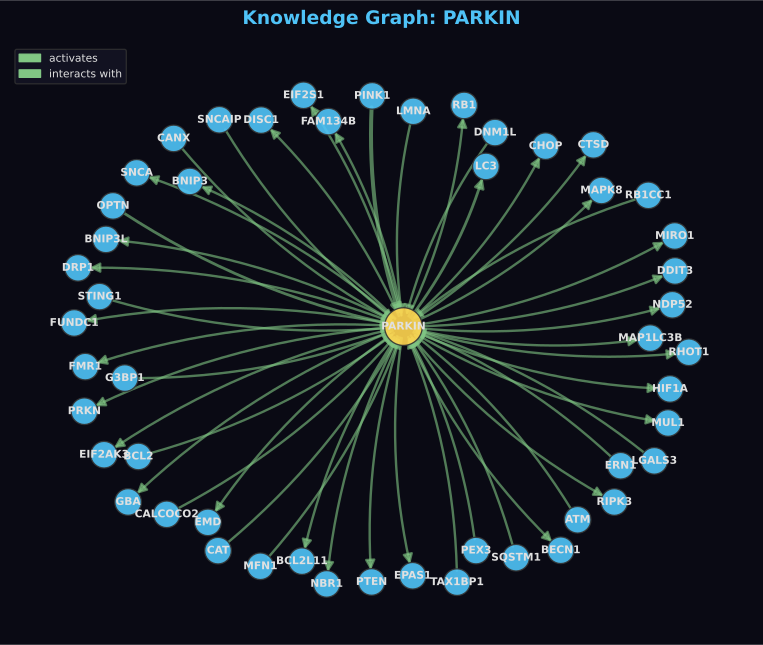
Pathway Diagrams (1)
Debate Impact (2)
Linked Wiki Pages (14)
Entities from this analysis that have detailed wiki pages