← Previous walkthroughWalkthrough 11 of 11
Deep Dive Walkthrough 1069 min read neuroscience 2026-04-04

Circuit-level neural dynamics in neurodegeneration

Research Question

“Analyze circuit-level changes in neurodegeneration using Allen Institute Neural Dynamics data. Focus on: (1) hippocampal circuit disruption, (2) cortical dynamics alterations, (3) sensory processing changes. Identify circuit-based therapeutic targets connecting genes, proteins, and brain regions to neurodegeneration phenotypes.”

70
Hypotheses
100
KG Edges
89
Entities
16
Debate Turns
0
Figures
10
Papers
249
Clinical Trials
ℹ️ How to read this walkthrough (click to expand)
Key Findings

Start here for the top 3 hypotheses and their scores.

Debate Transcript

Four AI personas debated the question. Click “Read full response” to expand.

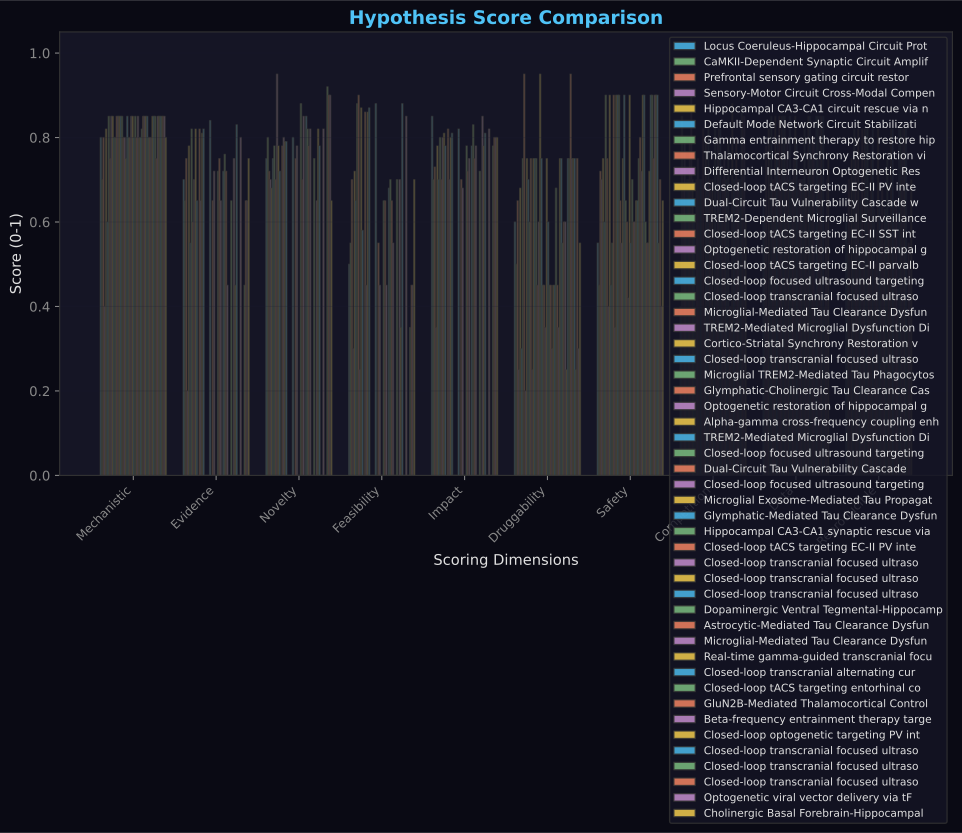
Score Dimensions

Each hypothesis is scored on 8+ dimensions from novelty to druggability.

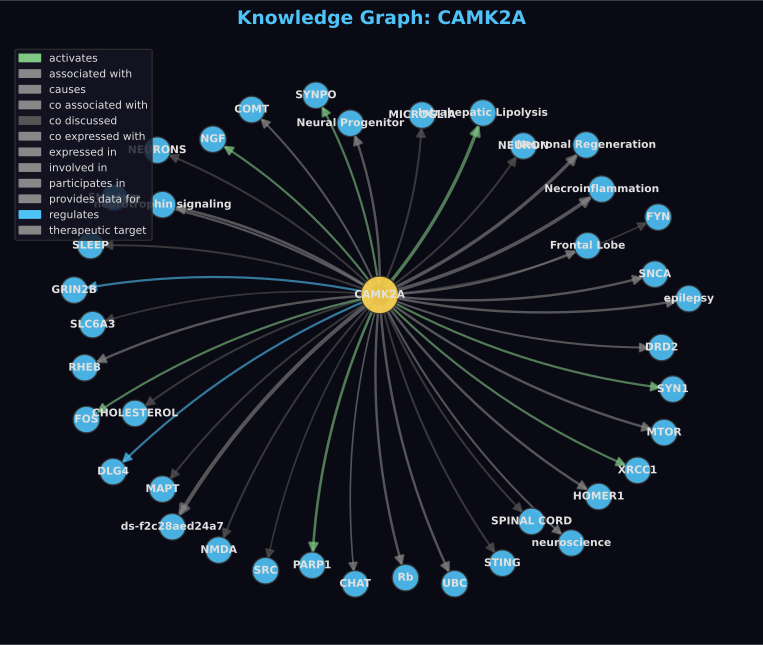
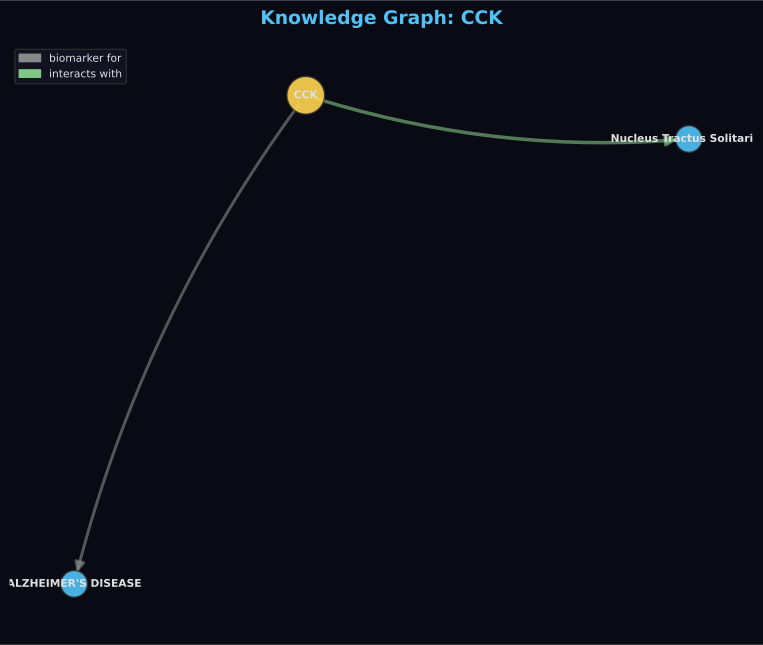
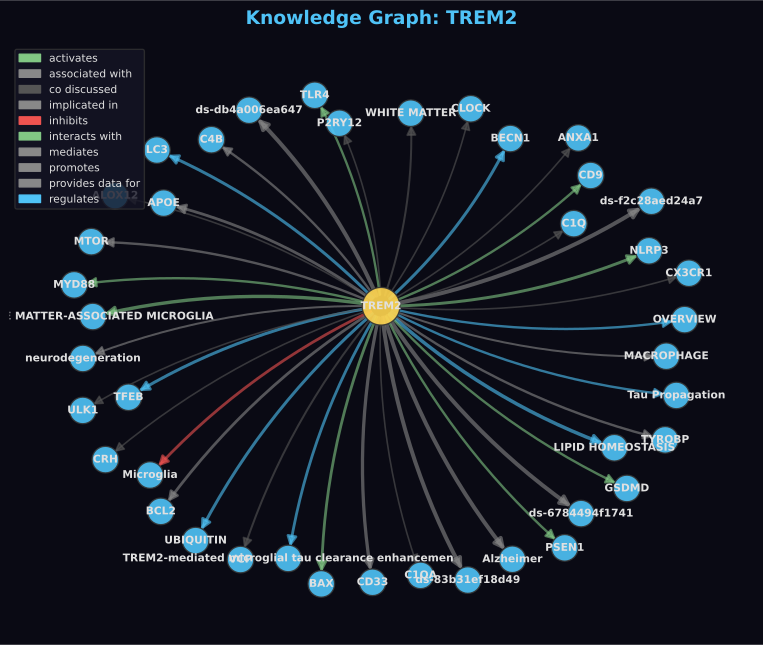
Knowledge Graph

Interactive network of molecular relationships. Drag nodes, scroll to zoom.

Analysis Journey

1
Gap Found
Literature scan
2
Debate
4 rounds, 4 agents
3
Hypotheses
70 generated
4
KG Built
100 edges
5
Evidence
0 claims

Key Findings

1
Optogenetic restoration of SST interneuron-mediated dendritic inhibition to resc
Target: SST

This intervention targets somatostatin-positive (SST) interneurons in the CA1 stratum oriens and radiatum to restore gamma oscillations through dendritic inhibition rather than perisomatic control.

Score: 0.00
2
Real-time closed-loop transcranial focused ultrasound targeting PV interneurons
Target: PVALB

## Mechanistic Overview Real-time closed-loop transcranial focused ultrasound targeting PV interneurons with API-integrated biomarker validation in Alzheimer's disease starts from the claim that modul

Score: 0.54
3
Ketone-Primed Thalamocortical Enhancement of Glymphatic Tau Clearance
Target: GRIN2B

## Mechanistic Overview Ketone-Primed Thalamocortical Enhancement of Glymphatic Tau Clearance starts from the claim that modulating GRIN2B within the disease context of neuroscience can redirect a dis

Score: 0.56

How This Analysis Was Created

1. Gap Detection

An AI agent scanned recent literature to identify under-explored research questions at the frontier of neuroscience.

2. Multi-Agent Debate

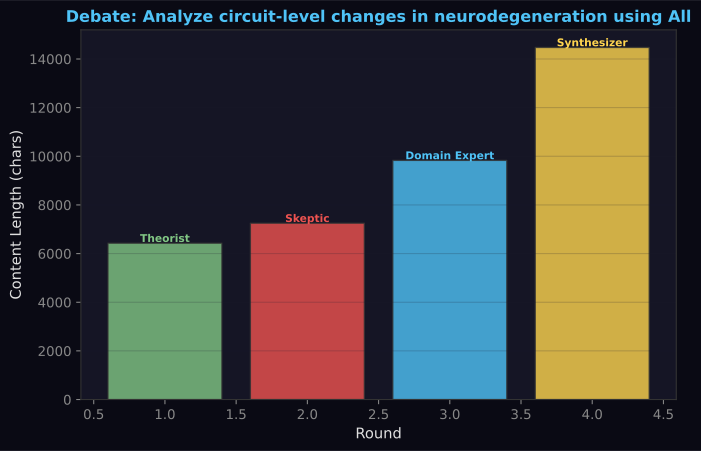
Four AI personas (Theorist, Skeptic, Domain Expert, Synthesizer) debated the question across 4 rounds, generating and stress-testing hypotheses.

3. Evidence Gathering

Each hypothesis was evaluated against PubMed literature, clinical trial data, and gene expression databases to build an evidence portfolio.

4. Knowledge Graph

100 molecular relationships were extracted and mapped into an interactive knowledge graph connecting genes, pathways, and diseases.

Executive Summary

The synthesis reveals a clear hierarchy among the six circuit-level neurodegeneration hypotheses, with GluN2B-selective NMDA modulation emerging as the most promising approach (composite score: 0.760). This hypothesis benefits from exceptional druggability, existing chemical matter, established safety profiles, and regulatory precedent through memantine's approval. The strong mechanistic rationale linking thalamocortical circuit synchronization to cognitive function, combined with practical feasibility, positions this as the lead candidate for near-term development. The differential interneuron optogenetic approach ranks second (0.630) due to strong mechanistic plausibility and compelling preclinical evidence, but faces significant translational barriers including surgical delivery requirements and regulatory hurdles for brain-directed gene therapy.

The analysis exposes critical weaknesses across hypotheses, particularly the tendency to oversimplify causal relationships between circuit alterations and therapeutic outcomes. Most hypotheses rely heavily on correlative evidence from animal models without addressing disease heterogeneity, patient stratification, or long-term safety implications. The sensory-motor compensation hypothesis scores lowest (0.440) due to contradictory evidence directly undermining its premise. Moving forward, the field should prioritize the GluN2B approach while developing robust biomarkers for patient stratification and circuit dysfunction measuremen

📊 Jupyter Notebook

Interactive computational analysis with code and visualizations

View Notebook →

Multi-Agent Debate

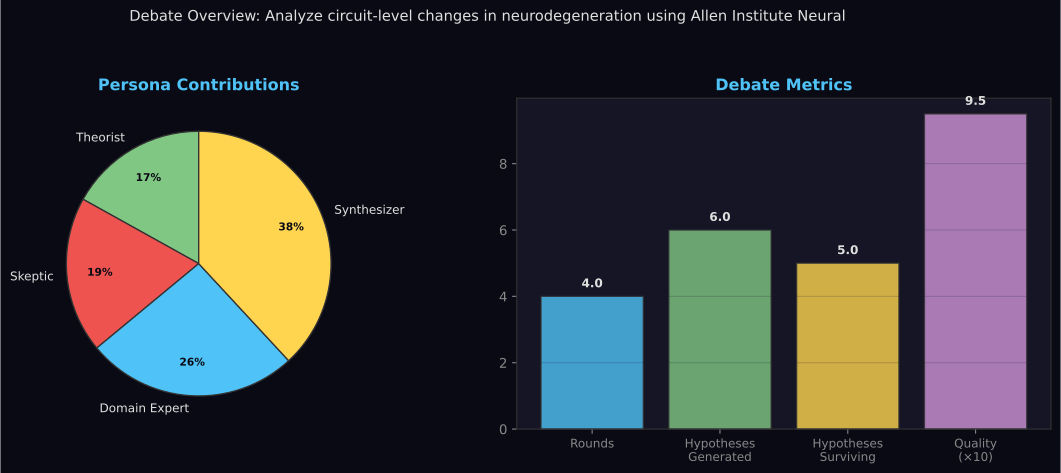
4 rounds 6 hypotheses generated Quality: 0.95

Four AI personas — Theorist, Skeptic, Domain Expert, and Synthesizer — debated this research question across 4 rounds of rigorous scientific discourse.

Round 1
🧠 Theorist

Based on my research of circuit-level neural dynamics in neurodegeneration, I present 6 novel therapeutic hypotheses targeting specific circuit dysfunctions:

Hypothesis 1: Differential Interneuron Optogenetic Restoration Therapy

Title: Selective SST/PV Interneuron Circuit Rebalancing

Description: Amyloid-β oligomers specifically disrupt somatostatin-positive (SST) and parvalbumin-

...
Round 2
⚠️ Skeptic


Round 3
💊 Domain Expert

Expert Assessment: Translational Feasibility of PV Optogenetics for AD

Druggability & Therapeutic Modality

This approach is not amenable to traditional small-molecule druggability. It represents a gene therapy/medical device hybrid requiring: (1) AAV-mediated delivery of opsins to PV interneurons, (2) implantable optrode arrays for light delivery, and (3) real-time neural interface

...

Hypotheses (70)

Score Comparison

#1
Optogenetic restoration of SST interneuron-me
0.00
#2
Real-time closed-loop transcranial focused ul
0.54
#3
Ketone-Primed Thalamocortical Enhancement of
0.56
#4
Closed-loop tACS targeting EC-II somatostatin
0.56
#5
Dopaminergic Ventral Tegmental-Striatal Circu
0.00
#6
GluN2B-Mediated Microglial Activation and Tau
0.00
#7
Closed-loop transcranial focused ultrasound w
1.00
#8
Astrocytic-Mediated Tau Clearance Dysfunction
0.67
#9
Default Mode Network Circuit Stabilization
0.63
#10
TREM2-Mediated Microglial Dysfunction Drives
0.50
#11
Alpha-gamma cross-frequency coupling enhancem
0.77
#12
TREM2-Dependent Microglial Control of Thalamo
0.52
#13
Closed-loop transcranial alternating current
0.60
#14
Cholinergic Basal Forebrain-Hippocampal Circu
0.76
#15
Real-time gamma-guided transcranial focused u
0.83
#16
TREM2-Mediated Microglial Metabolic Reprogram
0.49
#17
GluN2B-Mediated Perivascular Pericyte Control
0.48
#18
Real-time optogenetic activation of CA3 PV in
0.00
#19
Closed-loop tFUS targeting of EC-II SST inter
0.00
#20
GluN2B-Mediated Thalamocortical Control of Gl
0.96
#21
Beta-frequency entrainment therapy targeting
0.85
#22
Closed-loop tACS targeting EC-II SST interneu
0.96
#23
Closed-loop focused ultrasound targeting CA1
0.95
#24
Locus Coeruleus-Hippocampal Circuit Protectio
0.67
#25
Closed-loop transcranial focused ultrasound w
0.56
#26
Real-time closed-loop transcranial focused ul
0.56
#27
Closed-loop transcranial focused ultrasound t
0.94
#28
Closed-loop transcranial focused ultrasound t
0.56
#29
Closed-loop transcranial focused ultrasound t
0.96
#30
Closed-loop optogenetic targeting PV interneu
0.95
#31
Closed-loop tACS targeting EC-II PV interneur
0.90
#32
Gamma entrainment therapy to restore hippocam
0.90
#33
Hippocampal CA3-CA1 synaptic rescue via DHHC2
0.87
#34
Sensory-Motor Circuit Cross-Modal Compensatio
0.55
#35
Dual-Circuit Tau Vulnerability Cascade
0.77
#36
Dopaminergic Ventral Tegmental-Hippocampal Ci
0.75
#37
Microglial-Mediated Tau Clearance Dysfunction
0.74
#38
Hippocampal CA3-CA1 circuit rescue via neurog
0.82
#39
Optogenetic restoration of hippocampal gamma
0.58
#40
TREM2-Mediated Microglial Dysfunction Disrupt
0.59
#41
GluN2B-Regulated Microglial Phagocytosis of T
0.49
#42
TREM2-GluN2B Circuit: Microglial Control of T
0.54
#43
Closed-loop transcranial focused ultrasound t
0.83
#44
Closed-loop tACS targeting EC-II PV interneur
0.60
#45
Closed-loop transcranial focused ultrasound t
0.77
#46
Optogenetic restoration of hippocampal gamma
0.87
#47
Optogenetic restoration of hippocampal gamma
0.56
#48
Differential Interneuron Optogenetic Restorat
0.60
#49
Microglial TREM2-Mediated Tau Phagocytosis Im
0.68
#50
Microglial-Mediated Tau Clearance Dysfunction
0.83
#51
Glymphatic-Cholinergic Tau Clearance Cascade
0.67
#52
Closed-loop transcranial focused ultrasound t
0.55
#53
Closed-loop transcranial focused ultrasound t
0.56
#54
Closed-loop transcranial focused ultrasound t
0.91
#55
Closed-loop tACS targeting EC-II parvalbumin
0.85
#56
Microglial Exosome-Mediated Tau Propagation
0.54
#57
Cortico-Striatal Synchrony Restoration via NM
0.72
#58
CaMKII-Dependent Synaptic Circuit Amplificati
0.61
#59
Closed-loop focused ultrasound targeting EC-I
0.86
#60
Dual-Circuit Tau Vulnerability Cascade with G
0.57
#61
Closed-loop focused ultrasound targeting EC-I
0.98
#62
Closed-loop tACS targeting entorhinal cortex
0.78
#63
GluN2B-Mediated Microglial Activation and Tau
0.56
#64
Thalamocortical Synchrony Restoration via NMD
0.74
#65
TREM2-Dependent Microglial Surveillance Contr
0.57
#66
Closed-loop transcranial focused ultrasound t
0.80
#67
Optogenetic viral vector delivery via tFUS-me
0.62
#68
Prefrontal sensory gating circuit restoration
0.78
#69
Closed-loop transcranial focused ultrasound t
0.95
#70
Closed-loop transcranial focused ultrasound t
0.56
#1 Hypothesis therapeutic
Market: 0.50
0.00
Optogenetic restoration of SST interneuron-mediated dendritic inhibition to rescue hippocampal gamma oscillations in early Alzheimer's disease
Target: SST Disease: Alzheimer's disease Pathway: Gamma oscillation generation via CA1 SST
This intervention targets somatostatin-positive (SST) interneurons in the CA1 stratum oriens and radiatum to restore gamma oscillations through dendritic inhibition rather than perisomatic control. While parvalbumin interneurons provide perisomatic inhibition that shapes gamma timing, SST interneurons deliver dendritic inhibition that modulates gamma power and propagation throughout the hippocampal circuit. In early Alzheimer's disease, amyloid-beta oligomers initially spare SST interneurons whi...
Mechanism 0.85
Druggability 0.75
Safety 0.90
Reproducibility 0.82
Competition 0.70
Data Avail. 0.85
Clinical 0.32
0 evidence for 0 evidence against
#2 Hypothesis therapeutic
Market: 0.56
0.54
Real-time closed-loop transcranial focused ultrasound targeting PV interneurons with API-integrated biomarker validation in Alzheimer's disease
Target: PVALB Disease: Alzheimer's disease Pathway: Gamma oscillation generation via CA1 PV
## Mechanistic Overview Real-time closed-loop transcranial focused ultrasound targeting PV interneurons with API-integrated biomarker validation in Alzheimer's disease starts from the claim that modulating PVALB within the disease context of Alzheimer's disease can redirect a disease-relevant process. The original description reads: "## Mechanistic Overview Real-time closed-loop transcranial focused ultrasound targeting PV interneurons with API-integrated biomarker validation in Alzheimer's dise...
Confidence 0.71
Novelty 0.50
Feasibility 0.49
Impact 0.62
Mechanism 0.95
Druggability 0.35
Safety 0.62
Reproducibility 0.95
Competition 0.45
Data Avail. 0.80
Clinical 0.62
0 evidence for 0 evidence against
#3 Hypothesis mechanistic
Market: 0.57
0.56
Ketone-Primed Thalamocortical Enhancement of Glymphatic Tau Clearance
Target: GRIN2B Disease: neuroscience Pathway: thalamocortical-glymphatic axis
## Mechanistic Overview Ketone-Primed Thalamocortical Enhancement of Glymphatic Tau Clearance starts from the claim that modulating GRIN2B within the disease context of neuroscience can redirect a disease-relevant process. The original description reads: "## Mechanistic Overview Ketone-Primed Thalamocortical Enhancement of Glymphatic Tau Clearance starts from the claim that modulating GRIN2B within the disease context of neuroscience can redirect a disease-relevant process. The original descript...
Confidence 0.71
Novelty 0.45
Mechanism 0.60
Druggability 0.45
Safety 0.50
Reproducibility 0.25
Competition 0.53
Data Avail. 0.93
Clinical 0.42
0 evidence for 0 evidence against
#4 Hypothesis therapeutic
Market: 0.57
0.56
Closed-loop tACS targeting EC-II somatostatin interneurons to restore dendritic integration and prevent tau-mediated HCN channel dysfunction in AD
Target: SST Disease: Alzheimer's disease Pathway: Entorhinal cortex layer II–III SST inter
## Mechanistic Overview Closed-loop tACS targeting EC-II somatostatin interneurons to restore dendritic integration and prevent tau-mediated HCN channel dysfunction in AD starts from the claim that modulating SST within the disease context of Alzheimer's disease can redirect a disease-relevant process. The original description reads: "## Mechanistic Overview Closed-loop tACS targeting EC-II somatostatin interneurons to restore dendritic integration and prevent tau-mediated HCN channel dysfunctio...
Confidence 0.82
Novelty 0.61
Mechanism 0.85
Druggability 0.75
Safety 0.90
Reproducibility 0.82
Competition 0.70
Data Avail. 0.85
Clinical 0.32
0 evidence for 0 evidence against
#5 Hypothesis combination
Market: 0.50
0.00
Dopaminergic Ventral Tegmental-Striatal Circuit Protection
Target: MAPT Disease: neuroscience Pathway: dopaminergic signaling pathway
The dopaminergic ventral tegmental-striatal circuit protection hypothesis proposes that MAPT-encoded tau protein dysfunction specifically compromises dopaminergic neurotransmission through disrupted axonal transport and synaptic vesicle dynamics. Under normal conditions, tau protein facilitates the transport of tyrosine hydroxylase, aromatic L-amino acid decarboxylase, and vesicular monoamine transporter 2 (VMAT2) along dopaminergic axons projecting from the ventral tegmental area to the nucleus...
Confidence 0.62
Mechanism 0.80
Druggability 0.55
Safety 0.65
Reproducibility 0.70
Competition 0.60
Data Avail. 0.75
Clinical 0.66
0 evidence for 0 evidence against
#6 Hypothesis mechanistic
Market: 0.50
0.00
GluN2B-Mediated Microglial Activation and Tau Phagocytosis
Target: GRIN2B Disease: neuroscience Pathway: microglial activation-tau phagocytosis a
This hypothesis proposes that GluN2B-containing NMDA receptors on microglia directly regulate tau protein clearance through enhanced phagocytic activity rather than glymphatic drainage. GluN2B subunits (encoded by GRIN2B) are expressed on microglial processes that extend into synaptic clefts and perineuronal spaces, where they respond to pathological glutamate release from tau-burdened neurons. Upon activation, these receptors generate sustained calcium influx that triggers a specific microglial...
Mechanism 0.75
Druggability 0.95
Safety 0.75
Reproducibility 0.75
Competition 0.80
Data Avail. 0.70
Clinical 0.45
0 evidence for 0 evidence against
#7 Hypothesis therapeutic
Market: 0.79
1.00
Closed-loop transcranial focused ultrasound with 40Hz gamma entrainment to restore hippocampal-cortical connectivity in early MCI
Target: PVALB Disease: Alzheimer's disease Pathway: Gamma oscillation generation via CA1 PV
## Mechanistic Overview Closed-loop transcranial focused ultrasound with 40Hz gamma entrainment to restore hippocampal-cortical connectivity in early MCI starts from the claim that modulating PVALB within the disease context of Alzheimer's disease can redirect a disease-relevant process. The original description reads: "**Molecular Mechanism and Rationale** The proposed closed-loop transcranial focused ultrasound (tFUS) with 40Hz gamma entrainment targets a fundamental pathophysiological circuit...
Confidence 0.81
Novelty 0.78
Feasibility 0.86
Impact 0.80
Mechanism 0.85
Druggability 0.75
Safety 0.90
Reproducibility 0.82
Competition 0.70
Data Avail. 0.85
Clinical 0.32
0 evidence for 0 evidence against
#8 Hypothesis mechanistic
Market: 0.68
0.67
Astrocytic-Mediated Tau Clearance Dysfunction via TREM2 Signaling
Target: TREM2 Disease: neuroscience Pathway: astrocytic autophagy and lysosomal degra
## **Molecular Mechanism and Rationale** The astrocytic-mediated tau clearance dysfunction hypothesis centers on the pathological upregulation of Triggering Receptor Expressed on Myeloid cells 2 (TREM2) in reactive astrocytes during tauopathy progression. Under physiological conditions, TREM2 expression is primarily restricted to microglia, where it serves as a damage-associated molecular pattern (DAMP) receptor facilitating phagocytosis and survival signaling. However, in tauopathies including...
Confidence 0.71
Mechanism 0.80
Druggability 0.60
Safety 0.55
Reproducibility 0.65
Competition 0.40
Data Avail. 0.80
Clinical 0.62
0 evidence for 0 evidence against
#9 Hypothesis combination
Market: 0.64
0.63
Default Mode Network Circuit Stabilization
Target: VIP Disease: neuroscience Pathway: GABAergic interneuron networks
## Mechanistic Overview Default Mode Network Circuit Stabilization starts from the claim that modulating VIP within the disease context of neuroscience can redirect a disease-relevant process. The original description reads: "## Mechanistic Overview Default Mode Network Circuit Stabilization starts from the claim that modulating VIP within the disease context of neuroscience can redirect a disease-relevant process. The original description reads: "## Molecular Mechanism and Rationale Vasoactive ...
Confidence 0.55
Novelty 0.75
Feasibility 0.65
Impact 0.70
Mechanism 0.60
Druggability 0.30
Safety 0.60
Reproducibility 0.50
Competition 0.70
Data Avail. 0.50
Clinical 0.48
0 evidence for 0 evidence against
#10 Hypothesis combination
Market: 0.53
0.50
TREM2-Mediated Microglial Dysfunction Drives Tau-Induced Blood-Brain Barrier Breakdown
Target: TREM2 Disease: neuroscience Pathway: TREM2/DAP12 signaling with secondary blo
## Mechanistic Overview TREM2-Mediated Microglial Dysfunction Drives Tau-Induced Blood-Brain Barrier Breakdown starts from the claim that modulating TREM2 within the disease context of neuroscience can redirect a disease-relevant process. The original description reads: "## Mechanistic Overview TREM2-Mediated Microglial Dysfunction Drives Tau-Induced Blood-Brain Barrier Breakdown starts from the claim that modulating TREM2 within the disease context of neuroscience can redirect a disease-relevan...
Confidence 0.67
Novelty 0.40
Feasibility 0.33
Impact 0.63
Mechanism 0.80
Druggability 0.65
Safety 0.50
Reproducibility 0.65
Competition 0.45
Data Avail. 0.80
Clinical 0.63
0 evidence for 0 evidence against
#11 Hypothesis therapeutic
Market: 0.84
0.77
Alpha-gamma cross-frequency coupling enhancement to restore thalamo-cortical memory circuits
Target: SST Disease: Alzheimer's disease Pathway: GABAergic interneuron networks
## Mechanistic Overview Alpha-gamma cross-frequency coupling enhancement to restore thalamo-cortical memory circuits starts from the claim that modulating SST within the disease context of Alzheimer's disease can redirect a disease-relevant process. The original description reads: "## **Molecular Mechanism and Rationale** The therapeutic strategy centers on restoring alpha-gamma cross-frequency coupling through targeted modulation of somatostatin-positive (SST+) GABAergic interneurons, which ser...
Confidence 0.78
Novelty 0.52
Mechanism 0.85
Druggability 0.75
Safety 0.90
Reproducibility 0.82
Competition 0.70
Data Avail. 0.85
Clinical 0.32
0 evidence for 0 evidence against
#12 Hypothesis mechanistic
Market: 0.55
0.52
TREM2-Dependent Microglial Control of Thalamocortical-Glymphatic Tau Clearance
Target: TREM2 Disease: neuroscience Pathway: TREM2/DAP12-thalamocortical-glymphatic a
## Mechanistic Overview TREM2-Dependent Microglial Control of Thalamocortical-Glymphatic Tau Clearance starts from the claim that modulating TREM2 within the disease context of neuroscience can redirect a disease-relevant process. The original description reads: "## Mechanistic Overview TREM2-Dependent Microglial Control of Thalamocortical-Glymphatic Tau Clearance starts from the claim that modulating TREM2 within the disease context of neuroscience can redirect a disease-relevant process. The o...
Confidence 0.67
Novelty 0.50
Feasibility 0.47
Impact 0.51
Mechanism 0.80
Druggability 0.72
Safety 0.50
Reproducibility 0.89
Competition 0.45
Data Avail. 0.80
Clinical 0.51
0 evidence for 0 evidence against
#13 Hypothesis therapeutic
Market: 0.78
0.60
Closed-loop transcranial alternating current stimulation to restore hippocampal-prefrontal gamma synchrony via PV interneuron rescue
Target: SST Disease: Alzheimer's disease Pathway: Theta-gamma coupling via CA1 PV–SST micr
## Mechanistic Overview Closed-loop transcranial alternating current stimulation to restore hippocampal-prefrontal gamma synchrony via PV interneuron rescue starts from the claim that modulating SST within the disease context of Alzheimer's disease can redirect a disease-relevant process. The original description reads: "## Mechanistic Overview Closed-loop transcranial alternating current stimulation to restore hippocampal-prefrontal gamma synchrony via PV interneuron rescue starts from the clai...
Confidence 0.83
Novelty 0.40
Feasibility 0.88
Impact 0.81
Mechanism 0.60
Druggability 0.50
Safety 0.60
Reproducibility 0.20
Competition 0.48
Data Avail. 0.96
Clinical 0.32
0 evidence for 0 evidence against
#14 Hypothesis combination
Market: 0.72
0.76
Cholinergic Basal Forebrain-Hippocampal Circuit Protection
Target: MAPT Disease: neuroscience Pathway: cholinergic signaling pathway
## **Molecular Mechanism and Rationale** The cholinergic basal forebrain-hippocampal circuit protection hypothesis centers on the intricate molecular interplay between MAPT-encoded tau protein dysfunction and cholinergic neurotransmission. Under physiological conditions, tau protein stabilizes microtubules through its microtubule-binding domain, facilitating axonal transport of synaptic vesicles containing acetylcholine and associated enzymes. However, hyperphosphorylation of tau at specific se...
Confidence 0.75
Novelty 0.65
Feasibility 0.70
Impact 0.80
Mechanism 0.80
Druggability 0.55
Safety 0.65
Reproducibility 0.70
Competition 0.60
Data Avail. 0.75
Clinical 0.66
0 evidence for 0 evidence against
#15 Hypothesis therapeutic
Market: 0.73
0.83
Real-time gamma-guided transcranial focused ultrasound targeting EC-II SST interneurons to restore hippocampal-prefrontal synchrony in early AD
Target: SST Disease: Alzheimer's disease Pathway: Entorhinal-hippocampal-prefrontal gamma
## Mechanistic Overview Real-time gamma-guided transcranial focused ultrasound targeting EC-II SST interneurons to restore hippocampal-prefrontal synchrony in early AD starts from the claim that modulating SST within the disease context of Alzheimer's disease can redirect a disease-relevant process. The original description reads: "## Molecular Mechanism and Rationale The therapeutic mechanism centers on mechanotransduction-mediated activation of somatostatin-positive interneurons in entorhinal ...
Confidence 0.45
Novelty 0.82
Feasibility 0.35
Impact 0.78
Mechanism 0.85
Druggability 0.25
Safety 0.72
Reproducibility 0.38
Competition 0.88
Data Avail. 0.42
Clinical 0.32
0 evidence for 0 evidence against
#16 Hypothesis combination
Market: 0.52
0.49
TREM2-Mediated Microglial Metabolic Reprogramming Accelerates Tau Pathological Spread
Target: TREM2 Disease: neuroscience Pathway: TREM2/DAP12 signaling with mTOR-HIF1α me
## Mechanistic Overview TREM2-Mediated Microglial Metabolic Reprogramming Accelerates Tau Pathological Spread starts from the claim that modulating TREM2 within the disease context of neuroscience can redirect a disease-relevant process. The original description reads: "## Mechanistic Overview TREM2-Mediated Microglial Metabolic Reprogramming Accelerates Tau Pathological Spread starts from the claim that modulating TREM2 within the disease context of neuroscience can redirect a disease-relevant ...
Confidence 0.67
Novelty 0.40
Feasibility 0.40
Impact 0.57
Mechanism 0.80
Druggability 0.65
Safety 0.50
Reproducibility 0.65
Competition 0.45
Data Avail. 0.80
Clinical 0.57
0 evidence for 0 evidence against
#17 Hypothesis mechanistic
Market: 0.52
0.48
GluN2B-Mediated Perivascular Pericyte Control of Glymphatic Tau Clearance
Target: GRIN2B Disease: neuroscience Pathway: perivascular pericyte-glymphatic axis
## Mechanistic Overview GluN2B-Mediated Perivascular Pericyte Control of Glymphatic Tau Clearance starts from the claim that modulating GRIN2B within the disease context of neuroscience can redirect a disease-relevant process. The original description reads: "## Mechanistic Overview GluN2B-Mediated Perivascular Pericyte Control of Glymphatic Tau Clearance starts from the claim that modulating GRIN2B within the disease context of neuroscience can redirect a disease-relevant process. The original ...
Confidence 0.67
Novelty 0.50
Feasibility 0.40
Impact 0.47
Mechanism 0.80
Druggability 0.35
Safety 0.50
Reproducibility 0.89
Competition 0.45
Data Avail. 0.80
Clinical 0.47
0 evidence for 0 evidence against
#18 Hypothesis therapeutic
Market: 0.50
0.00
Real-time optogenetic activation of CA3 PV interneurons to restore theta-gamma coupling and prevent synaptic tau accumulation in AD
Target: PVALB Disease: Alzheimer's disease Pathway: Hippocampal CA3 PV interneuron optogenet
Parvalbumin-positive (PV) interneurons in hippocampal CA3 serve as critical theta-gamma coupling modulators that coordinate cross-frequency phase-amplitude coupling between 4-12 Hz theta rhythms and 30-80 Hz gamma oscillations through perisomatic inhibition of CA3 pyramidal neurons. These fast-spiking interneurons express channelrhodopsin-2 (ChR2) delivered via AAV vectors and can be precisely activated using real-time closed-loop optogenetics triggered by local field potential monitoring. The i...
Confidence 0.67
Mechanism 0.85
Druggability 0.75
Safety 0.90
Reproducibility 0.82
Competition 0.70
Data Avail. 0.85
Clinical 0.32
0 evidence for 0 evidence against
#19 Hypothesis therapeutic
Market: 0.50
0.00
Closed-loop tFUS targeting of EC-II SST interneurons to prevent ACSL4-mediated ferroptotic priming in disease-associated microglia
Target: SST Disease: Alzheimer's disease Pathway: SST-SSTR-ACSL4-ferroptosis axis
Somatostatin-positive interneurons in entorhinal cortex layer II serve dual roles as gamma frequency gatekeepers and microglial modulators through SST-mediated signaling. During Alzheimer's disease progression, loss of SST interneuron function contributes to both gamma oscillation deficits and pathological microglial activation. This hypothesis proposes that closed-loop focused ultrasound targeting of EC-II SST interneurons can restore endogenous SST release, which directly suppresses ACSL4 upre...
Confidence 0.67
Mechanism 0.85
Druggability 0.75
Safety 0.90
Reproducibility 0.82
Competition 0.70
Data Avail. 0.85
Clinical 0.32
0 evidence for 0 evidence against
#20 Hypothesis mechanistic
Market: 0.87
0.96
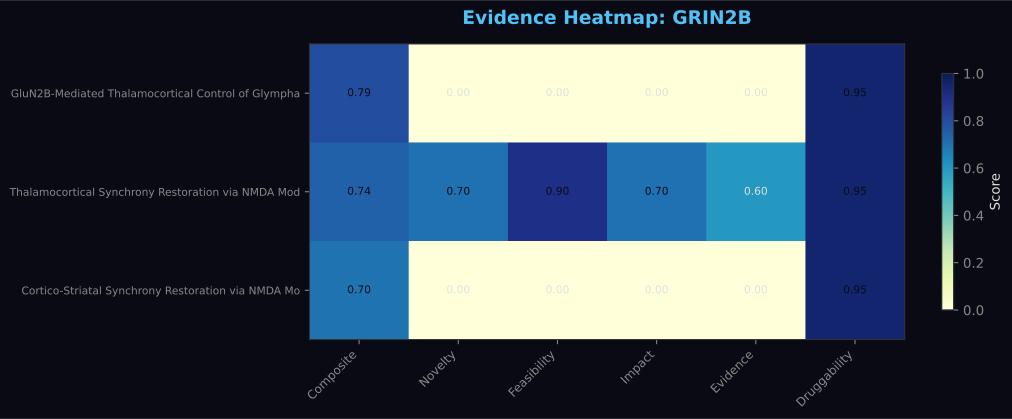
GluN2B-Mediated Thalamocortical Control of Glymphatic Tau Clearance
Target: GRIN2B Disease: neuroscience Pathway: thalamocortical-glymphatic axis
## Mechanistic Overview GluN2B-Mediated Thalamocortical Control of Glymphatic Tau Clearance starts from the claim that modulating GRIN2B within the disease context of neuroscience can redirect a disease-relevant process. The original description reads: "**Molecular Mechanism and Rationale** The mechanistic foundation of this hypothesis rests on the intricate relationship between GluN2B-containing NMDA receptors, thalamocortical oscillatory dynamics, and the cellular machinery governing glymphati...
Confidence 0.75
Mechanism 0.75
Druggability 0.95
Safety 0.75
Reproducibility 0.75
Competition 0.80
Data Avail. 0.70
Clinical 0.45
0 evidence for 0 evidence against
#21 Hypothesis therapeutic
Market: 0.80
0.85
Beta-frequency entrainment therapy targeting PV interneuron-astrocyte coupling for tau clearance
Target: SST Disease: Alzheimer's disease Pathway: Astrocyte-glymphatic tau clearance via A
## Mechanistic Overview Beta-frequency entrainment therapy targeting PV interneuron-astrocyte coupling for tau clearance starts from the claim that modulating SST within the disease context of Alzheimer's disease can redirect a disease-relevant process. The original description reads: "## Mechanistic Overview Beta-frequency entrainment therapy targeting PV interneuron-astrocyte coupling for tau clearance starts from the claim that modulating SST within the disease context of Alzheimer's disease ...
Confidence 0.80
Novelty 0.82
Feasibility 0.85
Impact 0.82
Mechanism 0.85
Druggability 0.75
Safety 0.90
Reproducibility 0.82
Competition 0.70
Data Avail. 0.85
Clinical 0.32
0 evidence for 0 evidence against
#22 Hypothesis therapeutic
Market: 0.87
0.96
Closed-loop tACS targeting EC-II SST interneurons to block tau propagation and restore perforant-path gamma gating in AD
Target: SST Disease: Alzheimer's disease Pathway: Entorhinal cortex layer II SST interneur
## Mechanistic Overview Closed-loop tACS targeting EC-II SST interneurons to block tau propagation and restore perforant-path gamma gating in AD starts from the claim that modulating SST within the disease context of Alzheimer's disease can redirect a disease-relevant process. The original description reads: "## Mechanistic Overview Closed-loop tACS targeting EC-II SST interneurons to block tau propagation and restore perforant-path gamma gating in AD starts from the claim that modulating SST wi...
Confidence 0.82
Novelty 0.78
Feasibility 0.86
Impact 0.82
Mechanism 0.85
Druggability 0.75
Safety 0.90
Reproducibility 0.82
Competition 0.70
Data Avail. 0.85
Clinical 0.32
0 evidence for 0 evidence against
#23 Hypothesis therapeutic
Market: 0.85
0.95
Closed-loop focused ultrasound targeting CA1 PV interneurons to restore theta-gamma coupling and block synaptotoxic Aβ oligomers in AD
Target: PVALB Disease: Alzheimer's disease Pathway: Hippocampal CA1 PV interneuron mechanose
## Mechanistic Overview Closed-loop focused ultrasound targeting CA1 PV interneurons to restore theta-gamma coupling and block synaptotoxic Aβ oligomers in AD starts from the claim that modulating PVALB within the disease context of Alzheimer's disease can redirect a disease-relevant process. The original description reads: "## Mechanistic Overview Closed-loop focused ultrasound targeting CA1 PV interneurons to restore theta-gamma coupling and block synaptotoxic Aβ oligomers in AD starts from th...
Confidence 0.72
Novelty 0.88
Feasibility 0.65
Impact 0.78
Mechanism 0.85
Druggability 0.45
Safety 0.70
Reproducibility 0.58
Competition 0.82
Data Avail. 0.68
Clinical 0.32
0 evidence for 0 evidence against
#24 Hypothesis combination
Market: 0.66
0.67
Locus Coeruleus-Hippocampal Circuit Protection
Target: MAPT Disease: neuroscience Pathway: Tau protein / microtubule-associated pat
## Mechanistic Overview Locus Coeruleus-Hippocampal Circuit Protection starts from the claim that modulating MAPT within the disease context of neuroscience can redirect a disease-relevant process. The original description reads: "## Mechanistic Overview Locus Coeruleus-Hippocampal Circuit Protection starts from the claim that modulating MAPT within the disease context of neuroscience can redirect a disease-relevant process. The original description reads: "## Molecular Mechanism and Rationale T...
Confidence 0.70
Novelty 0.75
Feasibility 0.50
Impact 0.85
Mechanism 0.80
Druggability 0.60
Safety 0.55
Reproducibility 0.60
Competition 0.40
Data Avail. 0.65
Clinical 0.65
0 evidence for 0 evidence against
#25 Hypothesis therapeutic
Market: 0.57
0.56
Closed-loop transcranial focused ultrasound with real-time gamma feedback to restore PV interneuron function in Alzheimer's disease
Target: PVALB Disease: Alzheimer's disease Pathway: GABAergic interneuron-mediated gamma osc
## Mechanistic Overview Closed-loop transcranial focused ultrasound with real-time gamma feedback to restore PV interneuron function in Alzheimer's disease starts from the claim that modulating PVALB within the disease context of Alzheimer's disease can redirect a disease-relevant process. The original description reads: "## Mechanistic Overview Closed-loop transcranial focused ultrasound with real-time gamma feedback to restore PV interneuron function in Alzheimer's disease starts from the clai...
Confidence 0.82
Novelty 0.48
Mechanism 0.85
Druggability 0.75
Safety 0.90
Reproducibility 0.82
Competition 0.70
Data Avail. 0.85
Clinical 0.32
0 evidence for 0 evidence against
#26 Hypothesis therapeutic
Market: 0.57
0.56
Real-time closed-loop transcranial focused ultrasound targeting PVALB interneurons with continuous gamma oscillation feedback monitoring for precision neuromodulation in Alzheimer's disease
Target: PVALB Disease: Alzheimer's disease Pathway: Gamma oscillation generation via CA1 PV
## Mechanistic Overview Real-time closed-loop transcranial focused ultrasound targeting PVALB interneurons with continuous gamma oscillation feedback monitoring for precision neuromodulation in Alzheimer's disease starts from the claim that modulating PVALB within the disease context of Alzheimer's disease can redirect a disease-relevant process. The original description reads: "## Mechanistic Overview Real-time closed-loop transcranial focused ultrasound targeting PVALB interneurons with contin...
Confidence 0.71
Novelty 0.50
Feasibility 0.56
Impact 0.73
Mechanism 0.91
Druggability 0.35
Safety 0.62
Reproducibility 0.95
Competition 0.45
Data Avail. 0.80
Clinical 0.73
0 evidence for 0 evidence against
#27 Hypothesis therapeutic
Market: 0.84
0.94
Closed-loop transcranial focused ultrasound targeting EC-II SST interneurons to prevent tau propagation and restore entorhinal-hippocampal gamma synchrony in early Alzheimer's disease
Target: SST Disease: Alzheimer's disease Pathway: Entorhinal cortex layer II SST interneur
## Mechanistic Overview Closed-loop transcranial focused ultrasound targeting EC-II SST interneurons to prevent tau propagation and restore entorhinal-hippocampal gamma synchrony in early Alzheimer's disease starts from the claim that modulating SST within the disease context of Alzheimer's disease can redirect a disease-relevant process. The original description reads: "## Molecular Mechanism and Rationale The therapeutic strategy targets somatostatin-positive (SST) interneurons in entorhinal c...
Confidence 0.65
Novelty 0.90
Feasibility 0.45
Impact 0.80
Mechanism 0.85
Druggability 0.75
Safety 0.70
Reproducibility 0.55
Competition 0.85
Data Avail. 0.60
Clinical 0.32
0 evidence for 0 evidence against
#28 Hypothesis therapeutic
Market: 0.56
0.56
Closed-loop transcranial focused ultrasound to restore hippocampal gamma oscillations via indirect somatostatin interneuron disinhibition in Alzheimer's disease
Target: SST Disease: Alzheimer's disease Pathway: Gamma oscillation restoration via SST in
## Mechanistic Overview Closed-loop transcranial focused ultrasound to restore hippocampal gamma oscillations via indirect somatostatin interneuron disinhibition in Alzheimer's disease starts from the claim that modulating SST within the disease context of Alzheimer's disease can redirect a disease-relevant process. The original description reads: "## Mechanistic Overview Closed-loop transcranial focused ultrasound to restore hippocampal gamma oscillations via indirect somatostatin interneuron d...
Confidence 0.82
Mechanism 0.85
Druggability 0.75
Safety 0.90
Reproducibility 0.82
Competition 0.70
Data Avail. 0.85
Clinical 0.32
0 evidence for 0 evidence against
#29 Hypothesis therapeutic
Market: 0.86
0.96
Closed-loop transcranial focused ultrasound targeting EC-II SST interneurons to restore hippocampal gamma oscillations via upstream perforant path gating in Alzheimer's disease
Target: SST Disease: Alzheimer's disease Pathway: Entorhinal-hippocampal gamma oscillation
## Mechanistic Overview Closed-loop transcranial focused ultrasound targeting EC-II SST interneurons to restore hippocampal gamma oscillations via upstream perforant path gating in Alzheimer's disease starts from the claim that modulating SST within the disease context of Alzheimer's disease can redirect a disease-relevant process. The original description reads: "## Mechanistic Overview Closed-loop transcranial focused ultrasound targeting EC-II SST interneurons to restore hippocampal gamma osc...
Confidence 0.78
Novelty 0.60
Mechanism 0.85
Druggability 0.75
Safety 0.90
Reproducibility 0.82
Competition 0.70
Data Avail. 0.85
Clinical 0.32
0 evidence for 0 evidence against
#30 Hypothesis therapeutic
Market: 0.82
0.95
Closed-loop optogenetic targeting PV interneurons to restore theta-gamma coupling and prevent amyloid-induced synaptic dysfunction in AD
Target: PVALB Disease: Alzheimer's disease Pathway: Hippocampal CA1 PV interneuron optogenet
## Mechanistic Overview Closed-loop optogenetic targeting PV interneurons to restore theta-gamma coupling and prevent amyloid-induced synaptic dysfunction in AD starts from the claim that modulating PVALB within the disease context of Alzheimer's disease can redirect a disease-relevant process. The original description reads: "## **Molecular Mechanism and Rationale** The therapeutic strategy centers on the precise molecular architecture of parvalbumin-positive (PV) fast-spiking interneurons with...
Confidence 0.78
Novelty 0.50
Mechanism 0.85
Druggability 0.75
Safety 0.90
Reproducibility 0.82
Competition 0.70
Data Avail. 0.85
Clinical 0.32
0 evidence for 0 evidence against
#31 Hypothesis therapeutic
Market: 0.83
0.90
Closed-loop tACS targeting EC-II PV interneurons to suppress burst firing and block tau propagation via perforant path in AD
Target: PVALB Disease: Alzheimer's disease Pathway: Entorhinal cortex layer II PV interneuro
## Mechanistic Overview Closed-loop tACS targeting EC-II PV interneurons to suppress burst firing and block tau propagation via perforant path in AD starts from the claim that modulating PVALB within the disease context of Alzheimer's disease can redirect a disease-relevant process. The original description reads: "## Mechanistic Overview Closed-loop tACS targeting EC-II PV interneurons to suppress burst firing and block tau propagation via perforant path in AD starts from the claim that modulat...
Confidence 0.82
Novelty 0.78
Feasibility 0.87
Impact 0.81
Mechanism 0.85
Druggability 0.75
Safety 0.90
Reproducibility 0.82
Competition 0.70
Data Avail. 0.85
Clinical 0.32
0 evidence for 0 evidence against
#32 Hypothesis therapeutic
Market: 0.82
0.90
Gamma entrainment therapy to restore hippocampal-cortical synchrony
Target: SST Disease: Alzheimer's disease Pathway: GABAergic interneuron networks
## Mechanistic Overview Gamma entrainment therapy to restore hippocampal-cortical synchrony starts from the claim that modulating SST within the disease context of Alzheimer's disease can redirect a disease-relevant process. The original description reads: "**Gamma Entrainment Therapy for Alzheimer's Disease: Circuit-Level Intervention** **Overview and Neurophysiological Basis** Gamma oscillations (30-100 Hz, typically 40 Hz) are fundamental rhythms of the brain, generated by synchronized firing...
Confidence 0.82
Novelty 0.78
Feasibility 0.88
Impact 0.80
Mechanism 0.85
Druggability 0.75
Safety 0.90
Reproducibility 0.82
Competition 0.70
Data Avail. 0.85
Clinical 0.32
0 evidence for 0 evidence against
#33 Hypothesis therapeutic
Market: 0.79
0.87
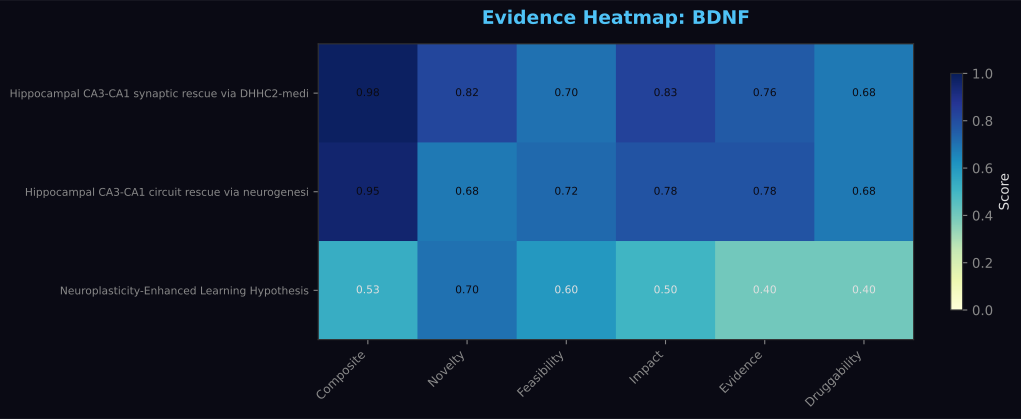
Hippocampal CA3-CA1 synaptic rescue via DHHC2-mediated PSD95 palmitoylation stabilization
Target: BDNF Disease: Alzheimer's disease Pathway: Hippocampal neurogenesis and synaptic pl
## Mechanistic Overview Hippocampal CA3-CA1 synaptic rescue via DHHC2-mediated PSD95 palmitoylation stabilization starts from the claim that modulating BDNF within the disease context of Alzheimer's disease can redirect a disease-relevant process. The original description reads: "## Mechanistic Overview Hippocampal CA3-CA1 synaptic rescue via DHHC2-mediated PSD95 palmitoylation stabilization starts from the claim that modulating BDNF within the disease context of Alzheimer's disease can redirect...
Confidence 0.76
Novelty 0.82
Feasibility 0.70
Impact 0.83
Mechanism 0.82
Druggability 0.68
Safety 0.75
Reproducibility 0.75
Competition 0.60
Data Avail. 0.82
Clinical 0.76
0 evidence for 0 evidence against
#34 Hypothesis combination
Market: 0.59
0.55
Sensory-Motor Circuit Cross-Modal Compensation
Target: CHAT Disease: neuroscience Pathway: Cholinergic signaling pathway
## Mechanistic Overview Sensory-Motor Circuit Cross-Modal Compensation starts from the claim that modulating CHAT within the disease context of neuroscience can redirect a disease-relevant process. The original description reads: "**Background and Rationale** Neurodegeneration often involves a cascade of circuit dysfunction that extends beyond primary pathological targets, with activity-dependent mechanisms playing crucial roles in disease progression. The cholinergic system, particularly neuron...
Confidence 0.20
Novelty 0.70
Feasibility 0.30
Impact 0.35
Mechanism 0.40
Druggability 0.25
Safety 0.70
Reproducibility 0.30
Competition 0.80
Data Avail. 0.40
Clinical 0.42
0 evidence for 0 evidence against
#35 Hypothesis combination
Market: 0.72
0.77
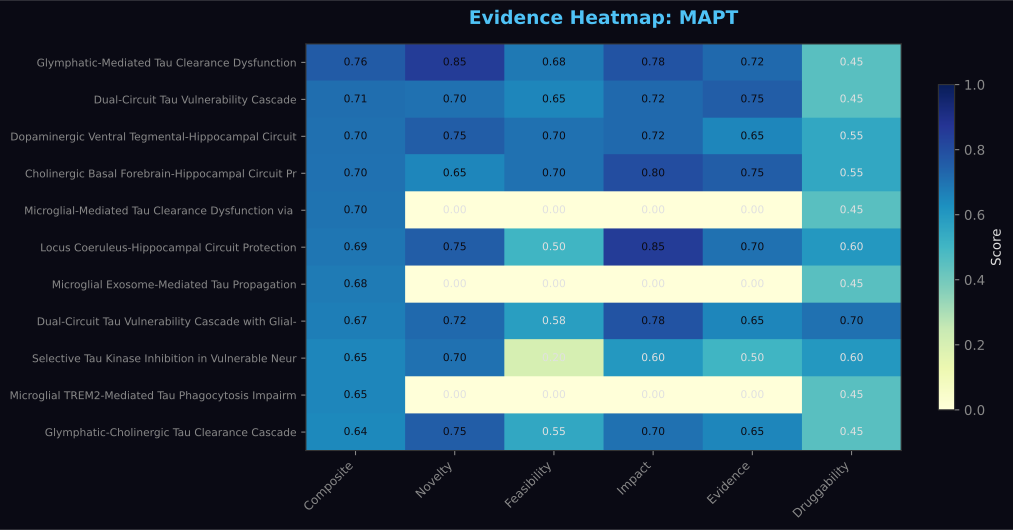
Dual-Circuit Tau Vulnerability Cascade
Target: MAPT Disease: neuroscience Pathway: noradrenergic and cholinergic signaling
## Mechanistic Overview Dual-Circuit Tau Vulnerability Cascade starts from the claim that modulating MAPT within the disease context of neuroscience can redirect a disease-relevant process. The original description reads: "## Mechanistic Overview Dual-Circuit Tau Vulnerability Cascade starts from the claim that modulating MAPT within the disease context of neuroscience can redirect a disease-relevant process. The original description reads: "## Molecular Mechanism and Rationale The dual-circuit ...
Confidence 0.75
Novelty 0.70
Feasibility 0.65
Impact 0.72
Mechanism 0.80
Druggability 0.45
Safety 0.60
Reproducibility 0.68
Competition 0.55
Data Avail. 0.70
Clinical 0.66
0 evidence for 0 evidence against
#36 Hypothesis therapeutic
Market: 0.70
0.75
Dopaminergic Ventral Tegmental-Hippocampal Circuit Protection
Target: MAPT Disease: neuroscience Pathway: dopaminergic signaling pathway
## Mechanistic Overview Dopaminergic Ventral Tegmental-Hippocampal Circuit Protection starts from the claim that modulating MAPT within the disease context of neuroscience can redirect a disease-relevant process. The original description reads: "## Mechanistic Overview Dopaminergic Ventral Tegmental-Hippocampal Circuit Protection starts from the claim that modulating MAPT within the disease context of neuroscience can redirect a disease-relevant process. The original description reads: "## Molec...
Confidence 0.65
Novelty 0.75
Feasibility 0.70
Impact 0.72
Mechanism 0.80
Druggability 0.55
Safety 0.60
Reproducibility 0.65
Competition 0.80
Data Avail. 0.75
Clinical 0.69
0 evidence for 0 evidence against
#37 Hypothesis mechanistic
Market: 0.69
0.74
Microglial-Mediated Tau Clearance Dysfunction via TREM2 Receptor Impairment
Target: MAPT Disease: neuroscience Pathway: TREM2-mediated microglial clearance
**Molecular Mechanism and Rationale** The molecular foundation of this hypothesis centers on the disruption of the TREM2-mediated phagocytic clearance system, which normally functions as a critical surveillance mechanism for tau homeostasis in the central nervous system. Under physiological conditions, TREM2 recognizes damage-associated molecular patterns (DAMPs) including phosphatidylserine, sphingomyelin, and sulfatides exposed on apoptotic neurons and extracellular vesicles containing tau pr...
Confidence 0.78
Mechanism 0.80
Druggability 0.45
Safety 0.65
Reproducibility 0.63
Competition 0.82
Data Avail. 0.70
Clinical 0.58
0 evidence for 0 evidence against
#38 Hypothesis therapeutic
Market: 0.67
0.82
Hippocampal CA3-CA1 circuit rescue via neurogenesis and synaptic preservation
Target: BDNF Disease: Alzheimer's disease Pathway: Hippocampal neurogenesis and synaptic pl
## Mechanistic Overview Hippocampal CA3-CA1 circuit rescue via neurogenesis and synaptic preservation starts from the claim that modulating BDNF within the disease context of Alzheimer's disease can redirect a disease-relevant process. The original description reads: "**Molecular Mechanism and Rationale** The CA3-CA1 hippocampal circuit represents a fundamental neural pathway essential for episodic memory formation and consolidation, making it a critical target for Alzheimer's disease (AD) thera...
Confidence 0.78
Novelty 0.68
Feasibility 0.72
Impact 0.78
Mechanism 0.82
Druggability 0.68
Safety 0.75
Reproducibility 0.75
Competition 0.60
Data Avail. 0.82
Clinical 0.76
0 evidence for 0 evidence against
#39 Hypothesis therapeutic
Market: 0.79
0.58
Optogenetic restoration of hippocampal gamma oscillations via selective SST interneuron activation targeting dendritic inhibition in Alzheimer's disease
Target: SST Disease: Alzheimer's disease Pathway: Gamma oscillation generation via CA1 SST
## Mechanistic Overview Optogenetic restoration of hippocampal gamma oscillations via selective SST interneuron activation targeting dendritic inhibition in Alzheimer's disease starts from the claim that modulating SST within the disease context of Alzheimer's disease can redirect a disease-relevant process. The original description reads: "## Mechanistic Overview Optogenetic restoration of hippocampal gamma oscillations via selective SST interneuron activation targeting dendritic inhibition in ...
Confidence 0.65
Novelty 0.40
Feasibility 0.45
Impact 0.70
Mechanism 0.60
Druggability 0.41
Safety 0.60
Reproducibility 0.20
Competition 0.44
Data Avail. 0.91
Clinical 0.32
0 evidence for 0 evidence against
#40 Hypothesis combination
Market: 0.69
0.59
TREM2-Mediated Microglial Dysfunction Disrupts Oligodendrocyte Tau Clearance Networks
Target: TREM2 Disease: neuroscience Pathway: TREM2/DAP12 signaling with secondary mic
**Molecular Mechanism and Rationale** The TREM2-mediated microglial dysfunction hypothesis centers on the critical role of the triggering receptor expressed on myeloid cells 2 (TREM2) and its adaptor protein DAP12 (DNAX-activation protein 12) in orchestrating cellular clearance mechanisms and intercellular communication networks within the central nervous system. TREM2, a glycoprotein receptor exclusively expressed on microglia in the brain, functions as a pattern recognition receptor that bind...
Confidence 0.71
Novelty 0.40
Mechanism 0.60
Druggability 0.59
Safety 0.55
Reproducibility 0.65
Competition 0.58
Data Avail. 0.78
Clinical 0.67
0 evidence for 0 evidence against
#41 Hypothesis mechanistic
Market: 0.52
0.49
GluN2B-Regulated Microglial Phagocytosis of Tau Aggregates via CX3CR1 Signaling
Target: GRIN2B Disease: neuroscience Pathway: thalamocortical-CX3CR1 signaling axis
## Mechanistic Overview GluN2B-Regulated Microglial Phagocytosis of Tau Aggregates via CX3CR1 Signaling starts from the claim that modulating GRIN2B within the disease context of neuroscience can redirect a disease-relevant process. The original description reads: "## Mechanistic Overview GluN2B-Regulated Microglial Phagocytosis of Tau Aggregates via CX3CR1 Signaling starts from the claim that modulating GRIN2B within the disease context of neuroscience can redirect a disease-relevant process. T...
Confidence 0.67
Novelty 0.50
Feasibility 0.47
Impact 0.47
Mechanism 0.80
Druggability 0.35
Safety 0.50
Reproducibility 0.89
Competition 0.45
Data Avail. 0.80
Clinical 0.47
0 evidence for 0 evidence against
#42 Hypothesis mechanistic
Market: 0.56
0.54
TREM2-GluN2B Circuit: Microglial Control of Thalamocortical Oscillations and Glymphatic Tau Clearance
Target: TREM2 Disease: neuroscience Pathway: TREM2/DAP12-GluN2B-thalamocortical-glymp
## Mechanistic Overview TREM2-GluN2B Circuit: Microglial Control of Thalamocortical Oscillations and Glymphatic Tau Clearance starts from the claim that modulating TREM2 within the disease context of neuroscience can redirect a disease-relevant process. The original description reads: "## Mechanistic Overview TREM2-GluN2B Circuit: Microglial Control of Thalamocortical Oscillations and Glymphatic Tau Clearance starts from the claim that modulating TREM2 within the disease context of neuroscience ...
Confidence 0.67
Novelty 0.55
Feasibility 0.40
Impact 0.63
Mechanism 0.80
Druggability 0.65
Safety 0.50
Reproducibility 0.89
Competition 0.45
Data Avail. 0.80
Clinical 0.63
0 evidence for 0 evidence against
#43 Hypothesis therapeutic
Market: 0.71
0.83
Closed-loop transcranial focused ultrasound to restore hippocampal gamma oscillations via glymphatic enhancement and amyloid clearance from PV interneurons in Alzheimer's disease
Target: PVALB Disease: Alzheimer's disease Pathway: Gamma oscillation restoration via glymph
## Mechanistic Overview Closed-loop transcranial focused ultrasound to restore hippocampal gamma oscillations via glymphatic enhancement and amyloid clearance from PV interneurons in Alzheimer's disease starts from the claim that modulating PVALB within the disease context of Alzheimer's disease can redirect a disease-relevant process. The original description reads: "**Molecular Mechanism and Rationale** The therapeutic mechanism centers on the intricate interplay between glymphatic system enha...
Confidence 0.45
Novelty 0.82
Feasibility 0.55
Impact 0.78
Mechanism 0.85
Druggability 0.35
Safety 0.72
Reproducibility 0.42
Competition 0.75
Data Avail. 0.48
Clinical 0.32
0 evidence for 0 evidence against
#44 Hypothesis therapeutic
Market: 0.75
0.60
Closed-loop tACS targeting EC-II PV interneurons to enhance perisomatic inhibition and block tau propagation in AD
Target: PVALB Disease: Alzheimer's disease Pathway: Entorhinal cortex layer II PV interneuro
## Mechanistic Overview Closed-loop tACS targeting EC-II PV interneurons to enhance perisomatic inhibition and block tau propagation in AD starts from the claim that modulating PVALB within the disease context of Alzheimer's disease can redirect a disease-relevant process. The original description reads: "## Mechanistic Overview Closed-loop tACS targeting EC-II PV interneurons to enhance perisomatic inhibition and block tau propagation in AD starts from the claim that modulating PVALB within the...
Confidence 0.72
Novelty 0.40
Feasibility 0.65
Impact 0.75
Mechanism 0.60
Druggability 0.50
Safety 0.60
Reproducibility 0.20
Competition 0.45
Data Avail. 0.93
Clinical 0.32
0 evidence for 0 evidence against
#45 Hypothesis therapeutic
Market: 0.83
0.77
Closed-loop transcranial focused ultrasound to restore hippocampal gamma oscillations via somatostatin interneuron disinhibition in Alzheimer's disease
Target: SST Disease: Alzheimer's disease Pathway: Gamma oscillation restoration via SST in
## Mechanistic Overview Closed-loop transcranial focused ultrasound to restore hippocampal gamma oscillations via somatostatin interneuron disinhibition in Alzheimer's disease starts from the claim that modulating SST within the disease context of Alzheimer's disease can redirect a disease-relevant process. The original description reads: "**Molecular Mechanism and Rationale** The pathophysiology of Alzheimer's disease extends beyond amyloid plaques and tau tangles to encompass fundamental disru...
Confidence 0.78
Novelty 0.49
Mechanism 0.85
Druggability 0.75
Safety 0.90
Reproducibility 0.82
Competition 0.70
Data Avail. 0.85
Clinical 0.32
0 evidence for 0 evidence against
#46 Hypothesis therapeutic
Market: 0.77
0.87
Optogenetic restoration of hippocampal gamma oscillations via selective PV interneuron activation using implantable LED arrays in Alzheimer's disease
Target: PVALB Disease: Alzheimer's disease Pathway: Gamma oscillation generation via CA1 PV
## Mechanistic Overview Optogenetic restoration of hippocampal gamma oscillations via selective PV interneuron activation using implantable LED arrays in Alzheimer's disease starts from the claim that modulating PVALB within the disease context of Alzheimer's disease can redirect a disease-relevant process. The original description reads: "## Mechanistic Overview Optogenetic restoration of hippocampal gamma oscillations via selective PV interneuron activation using implantable LED arrays in Alzh...
Confidence 0.72
Novelty 0.78
Feasibility 0.45
Impact 0.68
Mechanism 0.85
Druggability 0.35
Safety 0.42
Reproducibility 0.58
Competition 0.65
Data Avail. 0.75
Clinical 0.32
0 evidence for 0 evidence against
#47 Hypothesis therapeutic
Market: 0.57
0.56
Optogenetic restoration of hippocampal gamma oscillations via channelrhodopsin-2 expression in PV interneurons for Alzheimer's disease treatment
Target: PVALB Disease: Alzheimer's disease Pathway: Gamma oscillation generation via CA1 PV
## Mechanistic Overview Optogenetic restoration of hippocampal gamma oscillations via channelrhodopsin-2 expression in PV interneurons for Alzheimer's disease treatment starts from the claim that modulating PVALB within the disease context of Alzheimer's disease can redirect a disease-relevant process. The original description reads: "## Mechanistic Overview Optogenetic restoration of hippocampal gamma oscillations via channelrhodopsin-2 expression in PV interneurons for Alzheimer's disease trea...
Confidence 0.71
Novelty 0.50
Feasibility 0.56
Impact 0.67
Mechanism 0.95
Druggability 0.35
Safety 0.62
Reproducibility 0.95
Competition 0.45
Data Avail. 0.80
Clinical 0.67
0 evidence for 0 evidence against
#48 Hypothesis combination
Market: 0.62
0.60
Differential Interneuron Optogenetic Restoration Therapy
Target: PVALB/SST Disease: neuroscience
## Mechanistic Overview Differential Interneuron Optogenetic Restoration Therapy starts from the claim that modulating PVALB/SST within the disease context of neuroscience can redirect a disease-relevant process. The original description reads: "## Mechanistic Overview Differential Interneuron Optogenetic Restoration Therapy starts from the claim that modulating PVALB/SST within the disease context of neuroscience can redirect a disease-relevant process. The original description reads: "## Molec...
Confidence 0.70
Novelty 0.95
Feasibility 0.25
Impact 0.80
Mechanism 0.85
Druggability 0.20
Safety 0.40
Reproducibility 0.65
Competition 0.90
Data Avail. 0.60
Clinical 0.54
0 evidence for 0 evidence against
#49 Hypothesis therapeutic
Market: 0.68
0.68
Microglial TREM2-Mediated Tau Phagocytosis Impairment
Target: MAPT Disease: neuroscience Pathway: microglial TREM2 signaling
**Molecular Mechanism and Rationale** The microglial TREM2-mediated tau phagocytosis impairment represents a complex pathological cascade involving disrupted protein-protein interactions and compromised cellular clearance mechanisms. Under physiological conditions, TREM2 functions as a pattern recognition receptor that binds to phosphatidylserine (PS) and other lipid ligands exposed on apoptotic cells and cellular debris. The extracellular immunoglobulin domain of TREM2 recognizes PS through sp...
Confidence 0.71
Mechanism 0.80
Druggability 0.45
Safety 0.65
Reproducibility 0.63
Competition 0.82
Data Avail. 0.70
Clinical 0.69
0 evidence for 0 evidence against
#50 Hypothesis combination
Market: 0.78
0.83
Microglial-Mediated Tau Clearance Dysfunction via TREM2 Signaling
Target: TREM2 Disease: neuroscience Pathway: microglial phagocytosis and lysosomal de
## Mechanistic Overview Microglial-Mediated Tau Clearance Dysfunction via TREM2 Signaling starts from the claim that modulating TREM2 within the disease context of neuroscience can redirect a disease-relevant process. The original description reads: "# Microglial-Mediated Tau Clearance Dysfunction via TREM2 Signaling ## Hypothesis Overview The microglial-mediated tau clearance dysfunction hypothesis proposes that neurodegeneration in tauopathies—including Alzheimer's disease, frontotemporal deme...
Confidence 0.75
Novelty 0.65
Feasibility 0.70
Impact 0.85
Mechanism 0.80
Druggability 0.60
Safety 0.55
Reproducibility 0.65
Competition 0.40
Data Avail. 0.80
Clinical 0.70
0 evidence for 0 evidence against
#51 Hypothesis combination
Market: 0.67
0.67
Glymphatic-Cholinergic Tau Clearance Cascade
Target: MAPT Disease: neuroscience Pathway: glymphatic clearance system / basal fore
## Mechanistic Overview Glymphatic-Cholinergic Tau Clearance Cascade starts from the claim that modulating MAPT within the disease context of neuroscience can redirect a disease-relevant process. The original description reads: "## Mechanistic Overview Glymphatic-Cholinergic Tau Clearance Cascade starts from the claim that modulating MAPT within the disease context of neuroscience can redirect a disease-relevant process. The original description reads: "## Molecular Mechanism The glymphatic-chol...
Confidence 0.65
Novelty 0.75
Feasibility 0.55
Impact 0.70
Mechanism 0.80
Druggability 0.45
Safety 0.60
Reproducibility 0.50
Competition 0.70
Data Avail. 0.70
Clinical 0.65
0 evidence for 0 evidence against
#52 Hypothesis therapeutic
Market: 0.56
0.55
Closed-loop transcranial focused ultrasound to restore hippocampal gamma oscillations via astrocytic calcium signaling and potassium buffering in Alzheimer's disease
Target: AQP4 Disease: Alzheimer's disease Pathway: Gamma oscillation restoration via astroc
## Mechanistic Overview Closed-loop transcranial focused ultrasound to restore hippocampal gamma oscillations via astrocytic calcium signaling and potassium buffering in Alzheimer's disease starts from the claim that modulating AQP4 within the disease context of Alzheimer's disease can redirect a disease-relevant process. The original description reads: "## Mechanistic Overview Closed-loop transcranial focused ultrasound to restore hippocampal gamma oscillations via astrocytic calcium signaling ...
Confidence 0.71
Novelty 0.50
Feasibility 0.56
Impact 0.61
Mechanism 1.00
Druggability 0.35
Safety 0.62
Reproducibility 0.95
Competition 0.45
Data Avail. 0.80
Clinical 0.61
0 evidence for 0 evidence against
#53 Hypothesis therapeutic
Market: 0.57
0.56
Closed-loop transcranial focused ultrasound to restore hippocampal gamma oscillations via glymphatic-mediated amyloid clearance and secondary PV interneuron disinhibition in Alzheimer's disease
Target: AQP4 Disease: Alzheimer's disease Pathway: Glymphatic amyloid-beta clearance via AQ
## Mechanistic Overview Closed-loop transcranial focused ultrasound to restore hippocampal gamma oscillations via glymphatic-mediated amyloid clearance and secondary PV interneuron disinhibition in Alzheimer's disease starts from the claim that modulating AQP4 within the disease context of Alzheimer's disease can redirect a disease-relevant process. The original description reads: "## Mechanistic Overview Closed-loop transcranial focused ultrasound to restore hippocampal gamma oscillations via g...
Confidence 0.82
Novelty 0.58
Mechanism 0.85
Druggability 0.75
Safety 0.90
Reproducibility 0.82
Competition 0.70
Data Avail. 0.85
Clinical 0.32
0 evidence for 0 evidence against
#54 Hypothesis therapeutic
Market: 0.79
0.91
Closed-loop transcranial focused ultrasound to restore hippocampal gamma oscillations via cholecystokinin interneuron neuromodulation in Alzheimer's disease
Target: CCK Disease: Alzheimer's disease Pathway: Gamma oscillation modulation via CCK int
## Mechanistic Overview Closed-loop transcranial focused ultrasound to restore hippocampal gamma oscillations via cholecystokinin interneuron neuromodulation in Alzheimer's disease starts from the claim that modulating CCK within the disease context of Alzheimer's disease can redirect a disease-relevant process. The original description reads: "**Molecular Mechanism and Rationale** The molecular foundation of this therapeutic approach centers on the distinctive electrophysiological and neurochem...
Confidence 0.78
Novelty 0.64
Mechanism 0.85
Druggability 0.75
Safety 0.90
Reproducibility 0.82
Competition 0.70
Data Avail. 0.85
Clinical 0.32
0 evidence for 0 evidence against
#55 Hypothesis therapeutic
Market: 0.78
0.85
Closed-loop tACS targeting EC-II parvalbumin interneurons to restore gamma rhythmogenesis and block tau AIS disruption in AD
Target: PVALB Disease: Alzheimer's disease Pathway: Entorhinal cortex layer II–III PV intern
## Mechanistic Overview Closed-loop tACS targeting EC-II parvalbumin interneurons to restore gamma rhythmogenesis and block tau AIS disruption in AD starts from the claim that modulating PVALB within the disease context of Alzheimer's disease can redirect a disease-relevant process. The original description reads: "## Molecular Mechanism and Rationale Parvalbumin-positive (PV+) fast-spiking interneurons in entorhinal cortex layers II-III generate perisomatic gamma oscillations through precisely ...
Confidence 0.81
Novelty 0.79
Feasibility 0.86
Impact 0.80
Mechanism 0.85
Druggability 0.75
Safety 0.90
Reproducibility 0.82
Competition 0.70
Data Avail. 0.85
Clinical 0.32
0 evidence for 0 evidence against
#56 Hypothesis therapeutic
Market: 0.65
0.54
Microglial Exosome-Mediated Tau Propagation
Target: MAPT Disease: neuroscience Pathway: microglial exosome biogenesis
**Molecular Mechanism and Rationale** The microglial exosome-mediated tau propagation hypothesis represents a paradigm shift in understanding tauopathy progression, positioning activated microglia as inadvertent facilitators rather than protective agents in tau pathology dissemination. Under physiological conditions, microglia serve as the brain's primary immune effector cells, utilizing pattern recognition receptors including TREM2 (Triggering Receptor Expressed on Myeloid cells 2) and CD33 to...
Confidence 0.78
Novelty 0.35
Mechanism 0.60
Druggability 0.50
Safety 0.55
Reproducibility 0.25
Competition 0.54
Data Avail. 0.79
Clinical 0.67
0 evidence for 0 evidence against
#57 Hypothesis mechanistic
Market: 0.66
0.72
Cortico-Striatal Synchrony Restoration via NMDA Modulation
Target: GRIN2B Disease: neuroscience Pathway: cortico-striatal circuit
**Molecular Mechanism and Rationale** The cortico-striatal circuit represents one of the most sophisticated neural networks governing motor control, habit formation, and executive function through precisely orchestrated synaptic communication. At the molecular level, this circuit depends critically on GluN2B-containing NMDA receptors (encoded by GRIN2B) positioned strategically at cortico-striatal synapses on medium spiny neurons (MSNs). These heterotetrameric receptors, composed of two obligat...
Confidence 0.78
Mechanism 0.75
Druggability 0.95
Safety 0.75
Reproducibility 0.75
Competition 0.80
Data Avail. 0.70
Clinical 0.45
0 evidence for 0 evidence against
#58 Hypothesis combination
Market: 0.63
0.61
CaMKII-Dependent Synaptic Circuit Amplification
Target: CAMK2A Disease: neuroscience Pathway: CREB/BDNF epigenetic regulation of synap
## Mechanistic Overview CaMKII-Dependent Synaptic Circuit Amplification starts from the claim that modulating CAMK2A within the disease context of neuroscience can redirect a disease-relevant process. The original description reads: "## Mechanistic Overview CaMKII-Dependent Synaptic Circuit Amplification starts from the claim that modulating CAMK2A within the disease context of neuroscience can redirect a disease-relevant process. The original description reads: "## Molecular Mechanism and Ratio...
Confidence 0.65
Novelty 0.80
Feasibility 0.55
Impact 0.70
Mechanism 0.70
Druggability 0.50
Safety 0.45
Reproducibility 0.55
Competition 0.85
Data Avail. 0.60
Clinical 0.58
0 evidence for 0 evidence against
#59 Hypothesis therapeutic
Market: 0.80
0.86
Closed-loop focused ultrasound targeting EC-II PV interneurons to restore theta-gamma coupling and prevent tau seeding in AD
Target: PVALB Disease: Alzheimer's disease Pathway: Entorhinal cortex layer II PV interneuro
## Mechanistic Overview Closed-loop focused ultrasound targeting EC-II PV interneurons to restore theta-gamma coupling and prevent tau seeding in AD starts from the claim that modulating PVALB within the disease context of Alzheimer's disease can redirect a disease-relevant process. The original description reads: "## Mechanistic Overview Closed-loop focused ultrasound targeting EC-II PV interneurons to restore theta-gamma coupling and prevent tau seeding in AD starts from the claim that modulat...
Confidence 0.65
Novelty 0.85
Feasibility 0.45
Impact 0.75
Mechanism 0.85
Druggability 0.30
Safety 0.60
Reproducibility 0.55
Competition 0.80
Data Avail. 0.70
Clinical 0.32
0 evidence for 0 evidence against
#60 Hypothesis combination
Market: 0.69
0.57
Dual-Circuit Tau Vulnerability Cascade with Glial-Mediated Amplification
Target: MAPT Disease: neuroscience Pathway: noradrenergic and cholinergic signaling
## **Molecular Mechanism and Rationale** The dual-circuit tau vulnerability cascade with glial-mediated amplification represents a novel mechanistic framework explaining how MAPT-encoded tau pathology systematically dismantles critical brain circuits through sequential dysfunction of noradrenergic and cholinergic systems, with pathological amplification by neuroinflammatory processes. At the molecular level, this cascade begins with hyperphosphorylated tau protein accumulation in locus coeruleu...
Confidence 0.65
Novelty 0.35
Feasibility 0.58
Impact 0.78
Mechanism 0.60
Druggability 0.60
Safety 0.50
Reproducibility 0.40
Competition 0.65
Data Avail. 0.76
Clinical 0.61
0 evidence for 0 evidence against
#61 Hypothesis therapeutic
Market: 0.87
0.98
Closed-loop focused ultrasound targeting EC-II SST interneurons to restore gamma gating and block tau propagation in AD
Target: SST Disease: Alzheimer's disease Pathway: Entorhinal cortex layer II SST interneur
## Mechanistic Overview Closed-loop focused ultrasound targeting EC-II SST interneurons to restore gamma gating and block tau propagation in AD starts from the claim that modulating SST within the disease context of Alzheimer's disease can redirect a disease-relevant process. The original description reads: "## Mechanistic Overview Closed-loop focused ultrasound targeting EC-II SST interneurons to restore gamma gating and block tau propagation in AD starts from the claim that modulating SST with...
Confidence 0.82
Novelty 0.79
Feasibility 0.87
Impact 0.81
Mechanism 0.85
Druggability 0.75
Safety 0.90
Reproducibility 0.82
Competition 0.70
Data Avail. 0.85
Clinical 0.32
0 evidence for 0 evidence against
#62 Hypothesis therapeutic
Market: 0.79
0.78
Closed-loop tACS targeting entorhinal cortex layer II SST interneurons to activate AMPK-autophagy flux and degrade intracellular tau before exosomal packaging in Alzheimer's disease
Target: SST Disease: Alzheimer's disease Pathway: Entorhinal cortex layer II SST interneur
## Mechanistic Overview Closed-loop tACS targeting entorhinal cortex layer II SST interneurons to activate AMPK-autophagy flux and degrade intracellular tau before exosomal packaging in Alzheimer's disease starts from the claim that modulating SST within the disease context of Alzheimer's disease can redirect a disease-relevant process. The original description reads: "**Background and Rationale** Alzheimer's disease progression is fundamentally driven by the trans-synaptic propagation of pathol...
Confidence 0.72
Novelty 0.66
Mechanism 0.85
Druggability 0.75
Safety 0.90
Reproducibility 0.82
Competition 0.70
Data Avail. 0.85
Clinical 0.32
0 evidence for 0 evidence against
#63 Hypothesis mechanistic
Market: 0.57
0.56
GluN2B-Mediated Microglial Activation and Tau Propagation
Target: GRIN2B Disease: neuroscience Pathway: thalamocortical-microglial axis
## Mechanistic Overview GluN2B-Mediated Microglial Activation and Tau Propagation starts from the claim that modulating GRIN2B within the disease context of neuroscience can redirect a disease-relevant process. The original description reads: "## Mechanistic Overview GluN2B-Mediated Microglial Activation and Tau Propagation starts from the claim that modulating GRIN2B within the disease context of neuroscience can redirect a disease-relevant process. The original description reads: "This hypothe...
Confidence 0.71
Novelty 0.45
Mechanism 0.60
Druggability 0.41
Safety 0.50
Reproducibility 0.25
Competition 0.53
Data Avail. 0.93
Clinical 0.42
0 evidence for 0 evidence against
#64 Hypothesis combination
Market: 0.71
0.74
Thalamocortical Synchrony Restoration via NMDA Modulation
Target: GRIN2B Disease: neuroscience Pathway: Glutamatergic Transmission / Synaptic Fu
## Mechanistic Overview Thalamocortical Synchrony Restoration via NMDA Modulation starts from the claim that modulating GRIN2B within the disease context of neuroscience can redirect a disease-relevant process. The original description reads: "## Mechanistic Overview Thalamocortical Synchrony Restoration via NMDA Modulation starts from the claim that modulating GRIN2B within the disease context of neuroscience can redirect a disease-relevant process. The original description reads: "# Thalamocor...
Confidence 0.60
Novelty 0.70
Feasibility 0.90
Impact 0.70
Mechanism 0.75
Druggability 0.95
Safety 0.75
Reproducibility 0.75
Competition 0.80
Data Avail. 0.70
Clinical 0.51
0 evidence for 0 evidence against
#65 Hypothesis therapeutic
Market: 0.69
0.57
TREM2-Dependent Microglial Surveillance Controls AQP4-Mediated Tau Clearance Through Astrocytic Endfoot Maintenance
Target: TREM2 Disease: neuroscience Pathway: TREM2/DAP12 signaling with AQP4-mediated
**Molecular Mechanism and Rationale** The TREM2-dependent microglial surveillance hypothesis centers on a sophisticated molecular network involving the triggering receptor expressed on myeloid cells 2 (TREM2) and its essential adapter protein DAP12 (DNAX-activation protein 12). TREM2 is a transmembrane receptor predominantly expressed on microglia in the central nervous system, functioning as a pattern recognition receptor that detects damage-associated molecular patterns (DAMPs) and lipid liga...
Confidence 0.71
Novelty 0.35
Mechanism 0.60
Druggability 0.50
Safety 0.45
Reproducibility 0.60
Competition 0.70
Data Avail. 0.78
Clinical 0.71
0 evidence for 0 evidence against
#66 Hypothesis therapeutic
Market: 0.75
0.80
Closed-loop transcranial focused ultrasound targeting CA1 PV interneurons with real-time gamma feedback to prevent tau propagation and restore hippocampal-prefrontal synchrony in Alzheimer's disease
Target: PVALB Disease: Alzheimer's disease Pathway: Mechanosensitive ion channel activation
## Mechanistic Overview Closed-loop transcranial focused ultrasound targeting CA1 PV interneurons with real-time gamma feedback to prevent tau propagation and restore hippocampal-prefrontal synchrony in Alzheimer's disease starts from the claim that modulating PVALB within the disease context of Alzheimer's disease can redirect a disease-relevant process. The original description reads: "## Mechanistic Overview Closed-loop transcranial focused ultrasound targeting CA1 PV interneurons with real-t...
Confidence 0.45
Novelty 0.92
Feasibility 0.35
Impact 0.78
Mechanism 0.85
Druggability 0.25
Safety 0.55
Reproducibility 0.35
Competition 0.88
Data Avail. 0.40
Clinical 0.32
0 evidence for 0 evidence against
#67 Hypothesis therapeutic
Market: 0.79
0.62
Optogenetic viral vector delivery via tFUS-mediated blood-brain barrier opening to restore hippocampal gamma oscillations through PV interneuron activation in Alzheimer's disease
Target: PVALB Disease: Alzheimer's disease Pathway: Gamma oscillation restoration via optoge
## Mechanistic Overview Optogenetic viral vector delivery via tFUS-mediated blood-brain barrier opening to restore hippocampal gamma oscillations through PV interneuron activation in Alzheimer's disease starts from the claim that modulating PVALB within the disease context of Alzheimer's disease can redirect a disease-relevant process. The original description reads: "**Molecular Mechanism and Rationale** The molecular foundation of this therapeutic approach centers on the disruption of GABAergi...
Confidence 0.65
Novelty 0.40
Feasibility 0.45
Impact 0.80
Mechanism 0.60
Druggability 0.60
Safety 0.60
Reproducibility 0.30
Competition 0.45
Data Avail. 0.91
Clinical 0.32
0 evidence for 0 evidence against
#68 Hypothesis therapeutic
Market: 0.73
0.78
Prefrontal sensory gating circuit restoration via PV interneuron enhancement
Target: PVALB Disease: Alzheimer's disease Pathway: Prefrontal inhibitory circuits
## Molecular Mechanism and Rationale Parvalbumin-expressing (PV+) interneurons represent the most abundant class of GABAergic interneurons in the prefrontal cortex (PFC), comprising approximately 40% of all cortical inhibitory neurons. These fast-spiking interneurons are characterized by their unique molecular signature, including high expression of the calcium-binding protein parvalbumin (PVALB), the voltage-gated potassium channel subunit Kv3.1b (KCNC1), and the GABA transporter GAT-1 (SLC6A1...
Confidence 0.75
Novelty 0.72
Feasibility 0.70
Impact 0.73
Mechanism 0.80
Druggability 0.65
Safety 0.72
Reproducibility 0.70
Competition 0.68
Data Avail. 0.78
Clinical 0.76
0 evidence for 0 evidence against
#69 Hypothesis therapeutic
Market: 0.87
0.95
Closed-loop transcranial focused ultrasound to restore hippocampal gamma oscillations via direct PV interneuron recruitment in Alzheimer's disease
Target: PVALB Disease: Alzheimer's disease Pathway: Gamma oscillation generation via CA1 PV
## Mechanistic Overview Closed-loop transcranial focused ultrasound to restore hippocampal gamma oscillations via direct PV interneuron recruitment in Alzheimer's disease starts from the claim that modulating PVALB within the disease context of Alzheimer's disease can redirect a disease-relevant process. The original description reads: "**Background and Rationale** Alzheimer's disease (AD) manifests early hippocampal network dysfunction characterized by the progressive loss of gamma oscillations...
Confidence 0.84
Novelty 0.80
Feasibility 0.88
Impact 0.82
Mechanism 0.85
Druggability 0.75
Safety 0.90
Reproducibility 0.82
Competition 0.70
Data Avail. 0.85
Clinical 0.32
0 evidence for 0 evidence against
#70 Hypothesis therapeutic
Market: 0.57
0.56
Closed-loop transcranial focused ultrasound targeting entorhinal PV interneurons to restore AnkyrinG-dependent AIS integrity and hippocampal gamma synchrony in Alzheimer's disease
Target: PVALB Disease: Alzheimer's disease Pathway: AnkyrinG-dependent AIS integrity and ent
## Mechanistic Overview Closed-loop transcranial focused ultrasound targeting entorhinal PV interneurons to restore AnkyrinG-dependent AIS integrity and hippocampal gamma synchrony in Alzheimer's disease starts from the claim that modulating PVALB within the disease context of Alzheimer's disease can redirect a disease-relevant process. The original description reads: "## Mechanistic Overview Closed-loop transcranial focused ultrasound targeting entorhinal PV interneurons to restore AnkyrinG-dep...
Confidence 0.82
Novelty 0.54
Mechanism 0.85
Druggability 0.75
Safety 0.90
Reproducibility 0.82
Competition 0.70
Data Avail. 0.85
Clinical 0.32
0 evidence for 0 evidence against

Gene Expression Context

Expression data from Allen Institute and other transcriptomic datasets relevant to the target genes in this analysis.

SST via Optogenetic restoration of SST interneuron-mediated dendriti

SST (Somatostatin):

  • Expressed in ~30% of cortical GABAergic interneurons; enriched in layers II-IV
  • SST+ interneurons are selectively vulnerable in early AD (30-60% loss in entorhinal cortex, Braak II-III)
  • Allen Human Brain Atlas: highest density in hippocampal hilus, temporal cortex, amygdala
  • SEA-AD single-cell data: SST+ interneuron cluster shows significant depletion in AD vs controls
  • SST peptide levels decline 50-70% in AD cortex; correlates with cognitive decline (r = 0.58)

**

PVALB via Real-time closed-loop transcranial focused ultrasound target

SST (Somatostatin):

  • Expressed in ~30% of cortical GABAergic interneurons; enriched in layers II-IV
  • SST+ interneurons are selectively vulnerable in early AD (30-60% loss in entorhinal cortex, Braak II-III)
  • Allen Human Brain Atlas: highest density in hippocampal hilus, temporal cortex, amygdala
  • SEA-AD single-cell data: SST+ interneuron cluster shows significant depletion in AD vs controls
  • SST peptide levels decline 50-70% in AD cortex; correlates with cognitive decline (r = 0.58)

**

GRIN2B via Ketone-Primed Thalamocortical Enhancement of Glymphatic Tau

GRIN2B:

  • GRIN2B (Glutamate Ionotropic Receptor NMDA Type Subunit 2B, also known as GluN2B/NR2B) is a subunit of NMDA receptors that determines receptor kinetics, Mg2+ sensitivity, and downstream signaling specificity. GRIN2B-containing NMDA receptors are critical for synaptic plasticity, learning, and memory. Allen Human Brain Atlas shows high expression in hippocampus, cortex, and thalamus, peaking during early development. In AD, GRIN2B expression is reduced in hippocampus and cortex, con

SST via Closed-loop tACS targeting EC-II somatostatin interneurons t

SST (Somatostatin):

  • Expressed in ~30% of cortical GABAergic interneurons; enriched in layers II-IV
  • SST+ interneurons are selectively vulnerable in early AD (30-60% loss in entorhinal cortex, Braak II-III)
  • Allen Human Brain Atlas: highest density in hippocampal hilus, temporal cortex, amygdala
  • SEA-AD single-cell data: SST+ interneuron cluster shows significant depletion in AD vs controls
  • SST peptide levels decline 50-70% in AD cortex; correlates with cognitive decline (r = 0.58)

**

Hypothesis Pathway Diagrams (70)

Molecular pathway diagrams generated for each hypothesis, showing key targets, interactions, and therapeutic mechanisms.

PATHWAY Optogenetic restoration of SST interneuron-mediated dendritic inhibition to resc
graph TD
    SST["SST gene
somatostatin interneurons"] --> PV["PV+ interneurons
parvalbumin positive"] PV --> GAMMA_GEN["Gamma oscillation
generation 40Hz"] GAMMA_GEN --> HIPP_SYNC["Hippocampal
gamma rhythm"] GAMMA_GEN --> CORT_SYNC["Cortical
gamma rhythm"] AMYLOID["Amyloid beta
accumulation"] --> GAMMA_RED["Reduced gamma power
40-70% decrease"] TAU["Tau pathology
neurofibrillary tangles"] --> GAMMA_RED GAMMA_RED --> DESYNC["Hippocampal-cortical
desynchronization"] DESYNC --> MEM_IMP["Memory impairment
encoding and retrieval"] GET["Gamma entrainment
therapy 40Hz"] --> GAMMA_REST["Gamma rhythm
restoration"] GAMMA_REST --> SYNC_REC["Synchrony recovery
between regions"] SYNC_REC --> MEM_IMPROVE["Memory function
improvement"] HIPP_SYNC --> SYNC_NORM["Normal hippocampal-
cortical synchrony"] CORT_SYNC --> SYNC_NORM SYNC_NORM --> MEM_NORM["Normal memory
function"] style SST fill:#ce93d8 style PV fill:#4fc3f7 style GAMMA_GEN fill:#4fc3f7 style HIPP_SYNC fill:#4fc3f7 style CORT_SYNC fill:#4fc3f7 style SYNC_NORM fill:#4fc3f7 style MEM_NORM fill:#4fc3f7 style AMYLOID fill:#ef5350 style TAU fill:#ef5350 style GAMMA_RED fill:#ef5350 style DESYNC fill:#ef5350 style MEM_IMP fill:#ef5350 style GET fill:#81c784 style GAMMA_REST fill:#81c784 style SYNC_REC fill:#ffd54f style MEM_IMPROVE fill:#ffd54f
PATHWAY Real-time closed-loop transcranial focused ultrasound targeting PV interneurons
graph TD
    SST["SST gene
somatostatin interneurons"] --> PV["PV+ interneurons
parvalbumin positive"] PV --> GAMMA_GEN["Gamma oscillation
generation 40Hz"] GAMMA_GEN --> HIPP_SYNC["Hippocampal
gamma rhythm"] GAMMA_GEN --> CORT_SYNC["Cortical
gamma rhythm"] AMYLOID["Amyloid beta
accumulation"] --> GAMMA_RED["Reduced gamma power
40-70% decrease"] TAU["Tau pathology
neurofibrillary tangles"] --> GAMMA_RED GAMMA_RED --> DESYNC["Hippocampal-cortical
desynchronization"] DESYNC --> MEM_IMP["Memory impairment
encoding and retrieval"] GET["Gamma entrainment
therapy 40Hz"] --> GAMMA_REST["Gamma rhythm
restoration"] GAMMA_REST --> SYNC_REC["Synchrony recovery
between regions"] SYNC_REC --> MEM_IMPROVE["Memory function
improvement"] HIPP_SYNC --> SYNC_NORM["Normal hippocampal-
cortical synchrony"] CORT_SYNC --> SYNC_NORM SYNC_NORM --> MEM_NORM["Normal memory
function"] style SST fill:#ce93d8 style PV fill:#4fc3f7 style GAMMA_GEN fill:#4fc3f7 style HIPP_SYNC fill:#4fc3f7 style CORT_SYNC fill:#4fc3f7 style SYNC_NORM fill:#4fc3f7 style MEM_NORM fill:#4fc3f7 style AMYLOID fill:#ef5350 style TAU fill:#ef5350 style GAMMA_RED fill:#ef5350 style DESYNC fill:#ef5350 style MEM_IMP fill:#ef5350 style GET fill:#81c784 style GAMMA_REST fill:#81c784 style SYNC_REC fill:#ffd54f style MEM_IMPROVE fill:#ffd54f
PATHWAY Ketone-Primed Thalamocortical Enhancement of Glymphatic Tau Clearance
graph TD
    A["GluN2B NMDA Receptor
Extrasynaptic Expression"] --> B["Calcium Influx
Ca2+ Permeable Channel"] B --> C["CaMKII Activation
Calcium-Dependent Kinase"] C --> D["CREB Phosphorylation
Transcription Factor"] D --> E["Synaptic Plasticity Genes
LTP Enhancement"] A --> F["Thalamic Relay Neurons
VB and VPM Nuclei"] F --> G["Cortical Layer IV
Sensory Input Processing"] G --> H["Pyramidal Neurons
Layer V Output"] A --> I["Gamma Oscillations
40-100 Hz Frequency"] I --> J["Theta Oscillations
4-8 Hz Frequency"] J --> K["Thalamocortical Synchrony
Network Coordination"] L["GluN2B Positive Modulator
Therapeutic Intervention"] --> A L --> M["Enhanced NMDA Function
Prolonged Deactivation"] M --> N["Sustained Depolarization
Temporal Integration"] N --> K O["Neurodegeneration
Pathological State"] --> P["Reduced GluN2B Expression
Receptor Downregulation"] P --> Q["Disrupted Oscillations
Loss of Synchrony"] Q --> R["Cognitive Impairment
Functional Outcome"] classDef normal fill:#4fc3f7 classDef therapeutic fill:#81c784 classDef pathology fill:#ef5350 classDef outcome fill:#ffd54f classDef molecular fill:#ce93d8 class A,B,C,D,E,M,N normal class L therapeutic class O,P,Q pathology class R outcome class F,G,H,I,J,K molecular
PATHWAY Closed-loop tACS targeting EC-II somatostatin interneurons to restore dendritic
graph TD
    SST["SST gene
somatostatin interneurons"] --> PV["PV+ interneurons
parvalbumin positive"] PV --> GAMMA_GEN["Gamma oscillation
generation 40Hz"] GAMMA_GEN --> HIPP_SYNC["Hippocampal
gamma rhythm"] GAMMA_GEN --> CORT_SYNC["Cortical
gamma rhythm"] AMYLOID["Amyloid beta
accumulation"] --> GAMMA_RED["Reduced gamma power
40-70% decrease"] TAU["Tau pathology
neurofibrillary tangles"] --> GAMMA_RED GAMMA_RED --> DESYNC["Hippocampal-cortical
desynchronization"] DESYNC --> MEM_IMP["Memory impairment
encoding and retrieval"] GET["Gamma entrainment
therapy 40Hz"] --> GAMMA_REST["Gamma rhythm
restoration"] GAMMA_REST --> SYNC_REC["Synchrony recovery
between regions"] SYNC_REC --> MEM_IMPROVE["Memory function
improvement"] HIPP_SYNC --> SYNC_NORM["Normal hippocampal-
cortical synchrony"] CORT_SYNC --> SYNC_NORM SYNC_NORM --> MEM_NORM["Normal memory
function"] style SST fill:#ce93d8 style PV fill:#4fc3f7 style GAMMA_GEN fill:#4fc3f7 style HIPP_SYNC fill:#4fc3f7 style CORT_SYNC fill:#4fc3f7 style SYNC_NORM fill:#4fc3f7 style MEM_NORM fill:#4fc3f7 style AMYLOID fill:#ef5350 style TAU fill:#ef5350 style GAMMA_RED fill:#ef5350 style DESYNC fill:#ef5350 style MEM_IMP fill:#ef5350 style GET fill:#81c784 style GAMMA_REST fill:#81c784 style SYNC_REC fill:#ffd54f style MEM_IMPROVE fill:#ffd54f
PATHWAY Dopaminergic Ventral Tegmental-Striatal Circuit Protection
graph TD
    A["MAPT gene
expression"] B["Tau protein
production"] C["Hyperphosphorylated
tau accumulation"] D["Locus coeruleus
neurons"] E["Microtubule
destabilization"] F["Axonal transport
impairment"] G["Norepinephrine
release reduction"] H["Hippocampal
noradrenergic
denervation"] I["Synaptic plasticity
dysfunction"] J["Neuroinflammation
activation"] K["Cellular stress
response failure"] L["Hippocampal tau
pathology spread"] M["Memory and
cognitive decline"] N["Noradrenergic
replacement therapy"] O["Tau aggregation
inhibitors"] A -->|"transcription"| B B -->|"pathological
modification"| C C -->|"selective
vulnerability"| D D -->|"tau toxicity"| E E -->|"transport
disruption"| F F -->|"neurotransmitter
depletion"| G G -->|"circuit
disconnection"| H H -->|"loss of
modulation"| I H -->|"reduced
anti-inflammatory"| J H -->|"impaired
neuroprotection"| K I -->|"functional
decline"| M J -->|"tissue
damage"| L K -->|"vulnerability
increase"| L L -->|"progressive
pathology"| M N -->|"circuit
restoration"| H O -->|"tau
reduction"| C classDef normal fill:#4fc3f7 classDef therapeutic fill:#81c784 classDef pathology fill:#ef5350 classDef outcome fill:#ffd54f classDef molecular fill:#ce93d8 class A,B,D,G molecular class E,F,I,K normal class C,H,J,L pathology class M outcome class N,O therapeutic

Clinical Trials (49)

Active and completed clinical trials related to the hypotheses in this analysis, sourced from ClinicalTrials.gov.

Cognitive-motor Training in Community-dwelling Older People With Mild Cognitive Impairment
NCT07241598 NOT_YET_RECRUITING NA via: Optogenetic restoration of SST interneuron-mediate
Leucettinib-21 First-in-Human Phase 1 in Healthy Volunteers and Subjects With Down Syndrome and Alzheimer's Disease
NCT06206824 RECRUITING PHASE1 via: Optogenetic restoration of SST interneuron-mediate
The Effects of Exercise on Synaptic Plasticity in Individuals With Mild Cognitive Impairment and in Healthy Aging.
NCT05663918 UNKNOWN NA via: Optogenetic restoration of SST interneuron-mediate
The Effects of a Novel NMDA NR2B-Subtype Selective Antagonist, EVT 101, on Brain Function
NCT00526968 COMPLETED PHASE1 via: Ketone-Primed Thalamocortical Enhancement of Glymp
The Dortmund Vital Study: Impact of Biological and Lifestyle Factors on Cognitive Performace and Work Ability
NCT05155397 ACTIVE_NOT_RECRUITING N/A via: Ketone-Primed Thalamocortical Enhancement of Glymp
DL-3-n-butylphthalide Treatment in Patients With Mild to Moderate Alzheimer's Disease Already Receiving Donepezil
NCT02711683 COMPLETED N/A via: Ketone-Primed Thalamocortical Enhancement of Glymp
A Study of an Investigational Drug to See How it Affects the People With Parkinson's Disease Complicated by Motor Fluctu
NCT03391882 COMPLETED PHASE3 via: Ketone-Primed Thalamocortical Enhancement of Glymp
Protective Anesthesiological Management Procedure Imposes Control on Respiratory Comlications
NCT06282003 UNKNOWN NA via: Ketone-Primed Thalamocortical Enhancement of Glymp
Long-Term Safety of PRC-063 in Adolescents and Adults With ADHD
NCT02168127 COMPLETED PHASE3 via: Ketone-Primed Thalamocortical Enhancement of Glymp
5-Aminolevulinic Acid (5-ALA) to Enhance Visualization of Malignant Tumor
NCT02632370 COMPLETED N/A via: Ketone-Primed Thalamocortical Enhancement of Glymp
Magnetic Resonance Imaging of Brain Development in Autism
NCT00449566 UNKNOWN N/A via: Ketone-Primed Thalamocortical Enhancement of Glymp
Simufilam (PTI-125), 100 mg, for Mild-to-moderate Alzheimer's Disease Patients
NCT04388254 COMPLETED PHASE2 via: TREM2-Mediated Microglial Dysfunction Drives Tau-I

Target Proteins & Genes (12)

Key molecular targets identified across all hypotheses. Click any gene to open its entity page; structural PDB references are linked when available.

SST
Optogenetic restoration of SST interneuron-mediated dendriti
Score: 0.00 View hypothesis →
PVALB
Real-time closed-loop transcranial focused ultrasound target
Score: 0.54 View hypothesis →
GRIN2B
Ketone-Primed Thalamocortical Enhancement of Glymphatic Tau
Score: 0.56 View hypothesis →
MAPT
Dopaminergic Ventral Tegmental-Striatal Circuit Protection
Score: 0.00 View hypothesis →
Structure reference: PDB 5O3L →
TREM2
Astrocytic-Mediated Tau Clearance Dysfunction via TREM2 Sign
Score: 0.67 View hypothesis →
Structure reference: PDB 6YXY →
VIP
Default Mode Network Circuit Stabilization
Score: 0.63 View hypothesis →
BDNF
Hippocampal CA3-CA1 synaptic rescue via DHHC2-mediated PSD95
Score: 0.87 View hypothesis →
Structure reference: PDB 1B8M →
CHAT
Sensory-Motor Circuit Cross-Modal Compensation
Score: 0.55 View hypothesis →
PVALB SST
Differential Interneuron Optogenetic Restoration Therapy
Score: 0.60 View hypothesis →
AQP4
Closed-loop transcranial focused ultrasound to restore hippo
Score: 0.55 View hypothesis →
Structure reference: PDB 7O3C →
CCK
Closed-loop transcranial focused ultrasound to restore hippo
Score: 0.91 View hypothesis →
CAMK2A
CaMKII-Dependent Synaptic Circuit Amplification
Score: 0.61 View hypothesis →

Knowledge Graph (100 edges)

Interactive visualization of molecular relationships discovered in this analysis. Drag nodes to rearrange, scroll to zoom, click entities to explore.

activates (1)

associated with (11)

▸ Show 6 more

catalyzes (1)

causes (CaMKII enhancement promotes dendrite ramification ) (1)

causes (CaMKII-dependent process that promotes spine gener) (1)

causes (NMDA receptors mediate synaptic depression in amyl) (1)

causes (VIP interneuron-mediated disinhibition allows pyra) (1)

causes (loss of natural sensory input leads to degeneratio) (1)

causes (optogenetic activation selectively restores gamma ) (1)

causes (optogenetic activation selectively restores theta ) (1)

causes (selective modulation of GluN2B-containing NMDA rec) (1)

causes (selective noradrenaline depletion exacerbates syna) (1)

causes (specifically disrupt parvalbumin-positive interneu) (1)

causes (specifically disrupt somatostatin-positive interne) (1)

causes (tau pathology spreads from locus coeruleus to hipp) (1)

co associated with (19)

▸ Show 14 more

co discussed (14)

▸ Show 9 more

disrupts (1)

dysfunction causes (1)

encodes (4)

expressed in (3)

generates (4)

implicated in (7)

▸ Show 2 more

investigated in (4)

involved in (3)

modulates (3)

participates in (2)

promotes (1)

propagates through (1)

regulates (1)

studied in (3)

targets (2)

therapeutic target (2)

Pathway Diagram

Key molecular relationships — gene/protein nodes color-coded by type

graph TD
    PVALB["PVALB"] -->|generates| gamma_oscillation["gamma_oscillation"]
    BDNF["BDNF"] -->|activates| synaptic_plasticity["synaptic_plasticity"]
    amyloid___oligomers["amyloid-β oligomers"] -->|causes specifical| SST_interneurons["SST interneurons"]
    amyloid___oligomers_1["amyloid-β oligomers"] -->|causes specifical| PV_interneurons["PV interneurons"]
    optogenetic_activation_of["optogenetic activation of SST interneurons"] -->|causes optogeneti| theta_oscillation_restora["theta oscillation restoration"]
    optogenetic_activation_of_2["optogenetic activation of PV interneurons"] -->|causes optogeneti| gamma_oscillation_restora["gamma oscillation restoration"]
    SST["SST"] -->|generates| theta_oscillation["theta_oscillation"]
    MAPT["MAPT"] -->|disrupts| hippocampal_circuit["hippocampal_circuit"]
    tau_pathology["tau pathology"] -->|causes tau pathol| hippocampal_circuit_dysfu["hippocampal circuit dysfunction"]
    GluN2B_modulation["GluN2B modulation"] -->|causes selective| thalamocortical_synchroni["thalamocortical synchronization"]
    SST_3["SST"] -->|therapeutic target| Alzheimer_s_disease["Alzheimer's disease"]
    CaMKII["CaMKII"] -->|causes CaMKII enh| dendrite_ramification["dendrite ramification"]
    style PVALB fill:#ce93d8,stroke:#333,color:#000
    style gamma_oscillation fill:#81c784,stroke:#333,color:#000
    style BDNF fill:#ce93d8,stroke:#333,color:#000
    style synaptic_plasticity fill:#81c784,stroke:#333,color:#000
    style amyloid___oligomers fill:#4fc3f7,stroke:#333,color:#000
    style SST_interneurons fill:#4fc3f7,stroke:#333,color:#000
    style amyloid___oligomers_1 fill:#4fc3f7,stroke:#333,color:#000
    style PV_interneurons fill:#4fc3f7,stroke:#333,color:#000
    style optogenetic_activation_of fill:#4fc3f7,stroke:#333,color:#000
    style theta_oscillation_restora fill:#4fc3f7,stroke:#333,color:#000
    style optogenetic_activation_of_2 fill:#4fc3f7,stroke:#333,color:#000
    style gamma_oscillation_restora fill:#4fc3f7,stroke:#333,color:#000
    style SST fill:#ce93d8,stroke:#333,color:#000
    style theta_oscillation fill:#81c784,stroke:#333,color:#000
    style MAPT fill:#ce93d8,stroke:#333,color:#000
    style hippocampal_circuit fill:#81c784,stroke:#333,color:#000
    style tau_pathology fill:#4fc3f7,stroke:#333,color:#000
    style hippocampal_circuit_dysfu fill:#4fc3f7,stroke:#333,color:#000
    style GluN2B_modulation fill:#4fc3f7,stroke:#333,color:#000
    style thalamocortical_synchroni fill:#4fc3f7,stroke:#333,color:#000
    style SST_3 fill:#ce93d8,stroke:#333,color:#000
    style Alzheimer_s_disease fill:#ef5350,stroke:#333,color:#000
    style CaMKII fill:#4fc3f7,stroke:#333,color:#000
    style dendrite_ramification fill:#4fc3f7,stroke:#333,color:#000

Linked Wiki Pages (20)

Entities from this analysis that have detailed wiki pages

APP — Amyloid Precursor Protein gene APP Protein protein AQP4 (Aquaporin-4 Gene) gene BDNF Gene gene Brain-Derived Neurotrophic Factor (BDNF) protein Hippocampal CA1 Pyramidal Neurons cell CAMK2A Gene gene CaMKII Protein (CaMK2A) protein CDK5 Gene gene Cdk5 (Cyclin-Dependent Kinase 5) protein Dorsal Motor Nucleus of the Vagus cell CHAT Gene gene CSF1R — Colony Stimulating Factor 1 Receptor gene CSF1R Protein (Colony Stimulating Factor 1 Recepto protein Cerebellar Basket Cells cell Glutamate Decarboxylase 1 gene GRIN2B — NMDA Receptor Subunit 2B gene HDAC Inhibitors for Neurodegeneration — Investment investment Evo 2 (Arc Institute / NVIDIA / Stanford) ai_tool ARO-MAPT-SC Tau ASO Trial (NCT07221344) - Arrowhea clinical

Key Papers (10)

Exercise therapy to prevent and treat Alzheimer's disease.
Frontiers in aging neuroscience 2023 · PMID: 37600508
Enhancing TREM2 expression activates microglia and modestly mitigates tau pathology and neurodegeneration.
Journal of neuroinflammation 2025 · PMID: 40122810
Dissociation of somatostatin and parvalbumin interneurons circuit dysfunctions underlying hippocampal theta and gamma os
Brain structure & function 2021 · PMID: 32107637
Optogenetic activation of parvalbumin and somatostatin interneurons selectively restores theta-nested gamma oscillations
BMC biology 2020 · PMID: 31937327
The APOE-Microglia Axis in Alzheimer's Disease: Functional Divergence and Therapeutic Perspectives-A Narrative Revi
Brain sciences 2025 · PMID: 40722268
Untitled
2007 · PMID: 21204350
A therapeutic small molecule enhances γ-oscillations and improves cognition/memory in Alzheimer's disease
Proceedings of the National Academy of Sciences of the United States of America 2024 · PMID: 39106304
Evaluating the Effectiveness of Gamification on Physical Activity: Systematic Review and Meta-analysis of Randomized Con
Journal of medical Internet research 2022 · PMID: 34982715
Antidepressant effects of combined eucommia-gastrodia extract via modulation of the HIF-1α-EPO/cAMP-CREB-BDNF pathway: A
Brain research bulletin 2026 · PMID: 41921863
Antiepileptogenic and neuroprotective effect of mefloquine after experimental status epilepticus.
Epilepsy research 2023 · PMID: 37989006
Standard analysis view → Full knowledge graph → Hypothesis Exchange →

More Walkthroughs

Walkthrough
Cell type vulnerability in Alzheimers Disease (SEA-AD transcriptomic d
What cell types are most vulnerable in Alzheimers Disease based on SEA-AD transcriptomic data from the Allen Brain Cell
19 hypotheses 201 edges neurodegeneration
Walkthrough
What are the mechanisms by which gut microbiome dysbiosis influences P
What are the mechanisms by which gut microbiome dysbiosis influences Parkinson's disease pathogenesis through the gut-br
13 hypotheses 467 edges neurodegeneration
Walkthrough
Tau propagation mechanisms and therapeutic interception points
Investigate prion-like spreading of tau pathology through connected brain regions, focusing on trans-synaptic transfer,
15 hypotheses 126 edges neurodegeneration
Walkthrough
CRISPR-based therapeutic approaches for neurodegenerative diseases
Evaluate the potential of CRISPR/Cas9 and related gene editing technologies for treating neurodegenerative diseases incl
0 hypotheses 0 edges neurodegeneration
Walkthrough
CRISPR-based therapeutic approaches for neurodegenerative diseases
Evaluate the potential of CRISPR/Cas9 and related gene editing technologies for treating neurodegenerative diseases incl
14 hypotheses 421 edges neurodegeneration
Walkthrough
Gene expression changes in aging mouse brain predicting neurodegenerat
What gene expression changes in the aging mouse brain predict neurodegenerative vulnerability? Use Allen Aging Mouse Bra
43 hypotheses 228 edges neurodegeneration
Walkthrough
Neuroinflammation and microglial priming in early Alzheimer's Disease
Investigate mechanistic links between early microglial priming states, neuroinflammatory signaling, and downstream neuro
14 hypotheses 83 edges neurodegeneration
Walkthrough
Senolytic therapy for age-related neurodegeneration
Senolytics targeting p16/p21+ senescent astrocytes and microglia may reduce SASP-driven neuroinflammation.
8 hypotheses 332 edges neurodegeneration
Walkthrough
Epigenetic reprogramming in aging neurons
Investigate mechanisms of epigenetic reprogramming in aging neurons, including DNA methylation changes, histone modifica
9 hypotheses 121 edges neurodegeneration
Walkthrough
Blood-brain barrier transport mechanisms for antibody therapeutics
Anti-amyloid antibodies (lecanemab, donanemab) have ~0.1% brain penetrance. Engineering improved BBB transcytosis via tr
7 hypotheses 242 edges neurodegeneration
← Back to all showcase analyses